
Does ISO 9001 Require Mandatory Procedures?
No. ISO 9001:2026 does not require a single documented procedure, and neither did the 2015 edition. What the standard does require is documented information: a short list of documents you must keep available, and a longer list of records you must keep as evidence. Those requirements sit in seven clauses, 4 to 10.
So if you are asked how many mandatory procedures there are in ISO 9001:2026, the answer is none. The rest of this page lists what you do need, clause by clause, with the records you must keep and how long to keep them.
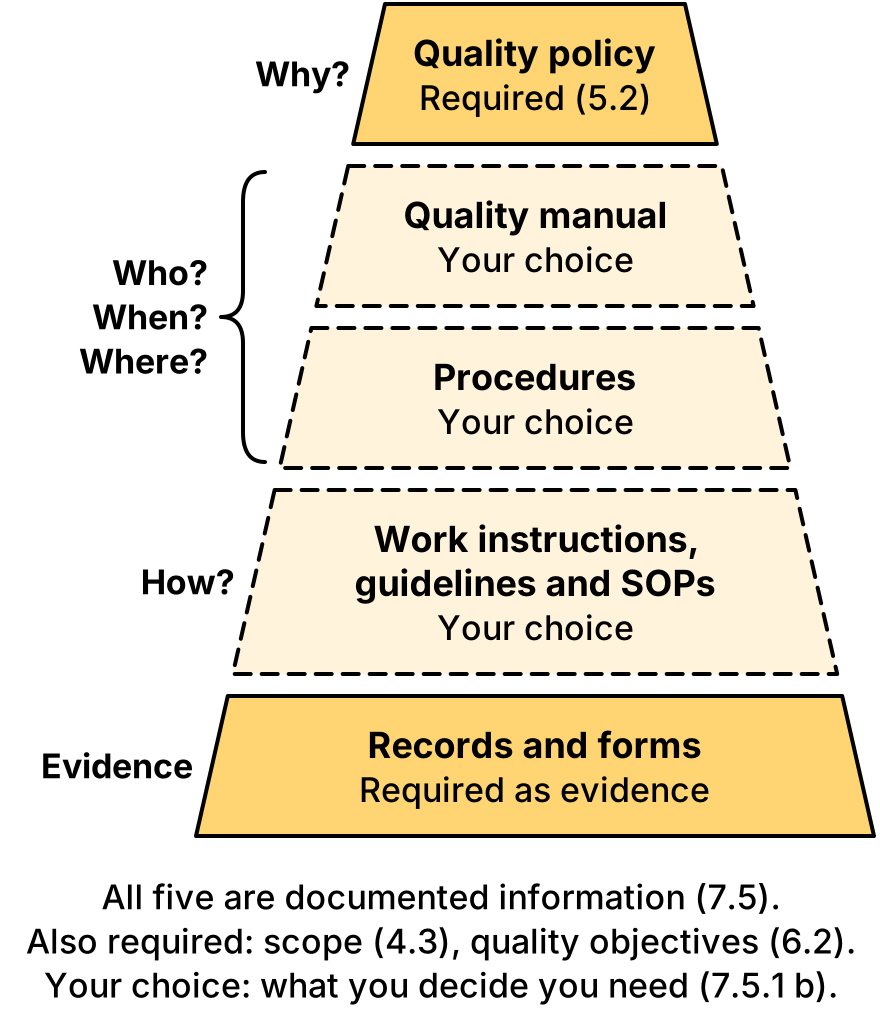
The pyramid shows how it fits together. The quality policy at the top is required. The quality manual, procedures and work instructions underneath are your choice. The records at the base are required as evidence. Clause 7.5.1 leaves the rest to you. Your quality management system also includes whatever documented information you decide it needs. How much that is depends on the size of your organization, the complexity of your processes and the competence of your people. For how the levels work together, see our guide to QMS documentation structure.
The Six Procedures ISO 9001:2008 Required
The question keeps coming up because older editions did ask for documented procedures. The six usually listed for ISO 9001:2008 are:
- Control of documents
- Control of records
- Internal audit
- Control of nonconforming product
- Corrective action
- Preventive action
ISO 9001:2015 dropped all six, and ISO 9001:2026 has not brought any back. The activities themselves are still required. You still control documented information (7.5.3), run internal audits (9.2), control nonconforming outputs (8.7) and take corrective action (10.2). You decide how to document them. Preventive action no longer has a clause of its own. Identifying the risks that could cause undesired effects, and acting on them, does the same job (6.1).

Mandatory Documents: What You Must Keep Available
Where ISO 9001:2026 says something "shall be available as documented information", it means a document. A document is information you keep up to date and available to the people who use it. The 2015 edition called this "maintaining" documented information. Five documents apply to every organization:
| Document | Clause | What ISO 9001:2026 asks for |
|---|---|---|
| Scope of the quality management system | 4.3 | The types of products and services covered, with a justification for any requirement you decide is not applicable |
| Information to support your processes | 4.4.2 a | Documented information to the extent necessary to support the operation of your processes |
| Quality policy | 5.2.2 a | Available as documented information, communicated within the organization and available to interested parties, as appropriate |
| Quality objectives | 6.2.1 | Measurable, monitored, communicated, updated as appropriate and available as documented information |
| Documented information the QMS needs | 7.5.1 | What ISO 9001 itself requires, plus whatever you decide is necessary for your QMS to be effective |
Two more apply only in some cases. When no international or national measurement standard exists, the basis you use for calibration or verification must be available as documented information (7.1.5.2). And as part of controlled production and service provision, where applicable, you need documented information that defines the characteristics of your products or services, the activities to be performed and the results to be achieved (8.5.1).
You will notice that the quality manual is not on the list. ISO 9001:2026 does not require one, although many organizations still keep one. Our guide explains when a quality manual is worth having.

Mandatory Records: Evidence You Must Keep
Where the standard says "documented information shall be available as evidence of", it means a record. A record is proof that something was done. The 2015 edition called this "retaining" documented information. These are the records ISO 9001:2026 asks for, clause by clause. Some only apply if you carry out that activity, such as design and development or looking after customer property.
| Record | Clause | Learn more |
|---|---|---|
| Evidence that processes are carried out as planned | 4.4.2 b | QMS and its processes |
| Evidence that monitoring and measuring resources are fit for purpose (calibration and verification records) | 7.1.5.1 | Monitoring and measuring resources |
| Evidence of competence: education, training and experience | 7.2 | Competence and awareness |
| Any other records you decide your QMS needs | 7.5.1 b | Control of documented information |
| Confidence that operational processes were carried out as planned, and evidence that products and services conform | 8.1 | – |
| Results of the review of requirements for products and services, and any new or changed requirements | 8.2.3.2 | Requirements for products and services |
| Design and development inputs, controls (reviews, verification, validation), outputs and changes | 8.3.3 to 8.3.6 | Design and development |
| Evaluation, selection, performance monitoring and re-evaluation of external providers | 8.4.1 | Externally provided processes, products and services |
| Traceability of outputs, where traceability is a requirement | 8.5.2 | Production and service provision |
| What happened when customer or external provider property was lost, damaged or found unsuitable | 8.5.3 | Production and service provision |
| Review of changes to production or service provision, who authorized them and any actions | 8.5.6 | Production and service provision |
| Release of products and services: conformity with the acceptance criteria and who authorized the release | 8.6 | – |
| Nonconforming outputs: the nonconformity, actions taken, concessions and who decided | 8.7.2 | Control of nonconforming outputs |
| Results of monitoring, measurement and the evaluation of QMS performance and effectiveness | 9.1.1 | – |
| Implementation of the audit programme and the audit results | 9.2.2 | Internal audit explained |
| Results of management reviews | 9.3.3 | Management review |
| The nature of nonconformities, actions taken and the results of corrective action | 10.2.2 | Corrective action |
Design planning (8.3.2) also asks you to decide what evidence you need to show design requirements have been met. Two items often turn up on ISO 9001 record lists by mistake: "communications with external parties" and "evaluation of compliance". Both come from ISO 14001. ISO 9001:2026 does not ask for records of either.
Learn more about the ISO 9001 requirements, clause by clause.

What Changed From ISO 9001:2015 to ISO 9001:2026?
ISO 9001:2026 was published on 16 September 2026 and replaces ISO 9001:2015. For documents and records, the change is mostly in the wording:
- "Maintain documented information" has become "shall be available as documented information". This is a document you keep up to date.
- "Retain documented information" has become "documented information shall be available as evidence of". This is a record. Annex A of the new standard (A.2 e) explains the difference. The first is about information being available. The second is about keeping objective evidence.
- There are still no mandatory procedures, and still no requirement for a quality manual.
- Risks and opportunities now have separate clauses (6.1.2 and 6.1.3), but neither asks for documented information.
Certificates issued to ISO 9001:2015 must move to the 2026 edition by 30 September 2029. Our guide to the ISO 9001:2026 revision covers the other changes and the transition timeline. Our complete ISO 9001 documentation templates have been updated to ISO 9001:2026.

How Long Should You Keep ISO 9001 Records?
ISO 9001 does not set a retention period for any record. Clause 7.5.3.2 leaves that to you. For the documented information you control, you must deal with storage and preservation, control of changes, and retention and disposition. Records kept as evidence of conformity must also be protected from unintended alterations.
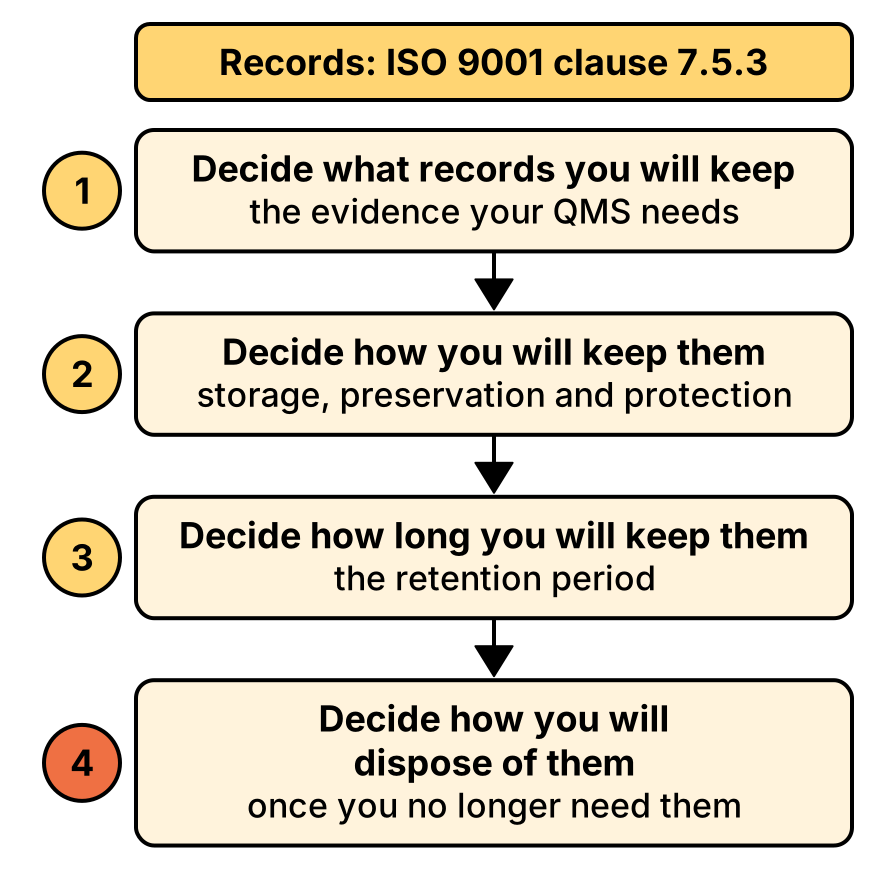
So decide how long each type of record is kept, write it down, and stick to it. Three things usually set the period: the law where you operate, what your customers' contracts say, and how long your products stay in use. Your certification body will also want to see records covering the period since its last visit.
| Record | What usually sets the period | A rule you might write |
|---|---|---|
| Calibration and verification (7.1.5) | How long the equipment is used, and how far back a faulty instrument could affect results | Keep for the life of the instrument |
| Competence and training (7.2) | Employment law and how long the person works for you | Keep while the person is employed, then follow your HR retention rules |
| Release and traceability (8.5.2, 8.6) | Product lifetime, warranty terms and customer contracts | Keep for the product's expected life or the warranty period, whichever is longer |
| Contract and order review (8.2.3.2) | Contract terms and legal claim periods | Keep for the contract term plus the legal claim period |
| Internal audits and management reviews (9.2.2, 9.3.3) | Your certification cycle | Keep at least until your certification body has reviewed them |
| Nonconformities and corrective action (8.7.2, 10.2.2) | Spotting repeat problems and trends | Keep long enough to show trends across a full certification cycle |
A simple retention schedule does the job. List the record type, the owner, where it is kept, how long it is kept, and how it is disposed of. Make it part of your control of documented information, and keep obsolete documents out of everyday use.

Documents Required for ISO 9001 Certification
A certification auditor checks two things. First, that the documented information ISO 9001 requires exists. Second, that your records show the system working. Certification bodies usually split the first audit into two parts, often called stage 1 and stage 2. Stage 1 is a review of your documentation and readiness. Stage 2 is an audit of how the system works in practice. Have these ready:
- Your scope (4.3), quality policy (5.2) and quality objectives with your plans to achieve them (6.2)
- Information on your processes and how they interact (4.4). A process map is the usual way to show it.
- Records of at least one internal audit (9.2.2) and one management review (9.3.3). Both clauses ask for evidence, so the auditor will expect to see that they have taken place.
- The records from the table above that apply to your activities: competence, calibration, supplier evaluation, release, nonconformities and corrective actions
- Any procedures and work instructions you have chosen to write
Our guide to preparing for your ISO 9001 certification audit suggests having at least two to three months of records from your procedures before the audit.

The Seven ISO 9001 Clauses With Documentation Requirements
ISO 9001:2026 has ten clauses. Clauses 1 to 3 cover the scope of the standard, normative references and terms, and place no requirements on you. Every one of clauses 4 to 10 asks for documented information:
- Clause 4, Context of the organization - the scope (4.3) and process information (4.4.2)
- Clause 5, Leadership - the quality policy (5.2.2)
- Clause 6, Planning - quality objectives (6.2.1)
- Clause 7, Support - monitoring and measuring resources (7.1.5), competence (7.2) and the control of documented information itself (7.5)
- Clause 8, Operation - operational planning, requirements review, design and development, external providers, production, release and nonconforming outputs (8.1 to 8.7)
- Clause 9, Performance evaluation - monitoring results (9.1.1), internal audit (9.2.2) and management review (9.3.3)
- Clause 10, Improvement - nonconformity and corrective action (10.2.2)

If There Are No Mandatory Procedures, What Procedures Should I Document?
ISO 9001:2026 requires no documented procedures. This is our advice: whatever your industry, we recommend documenting these five:
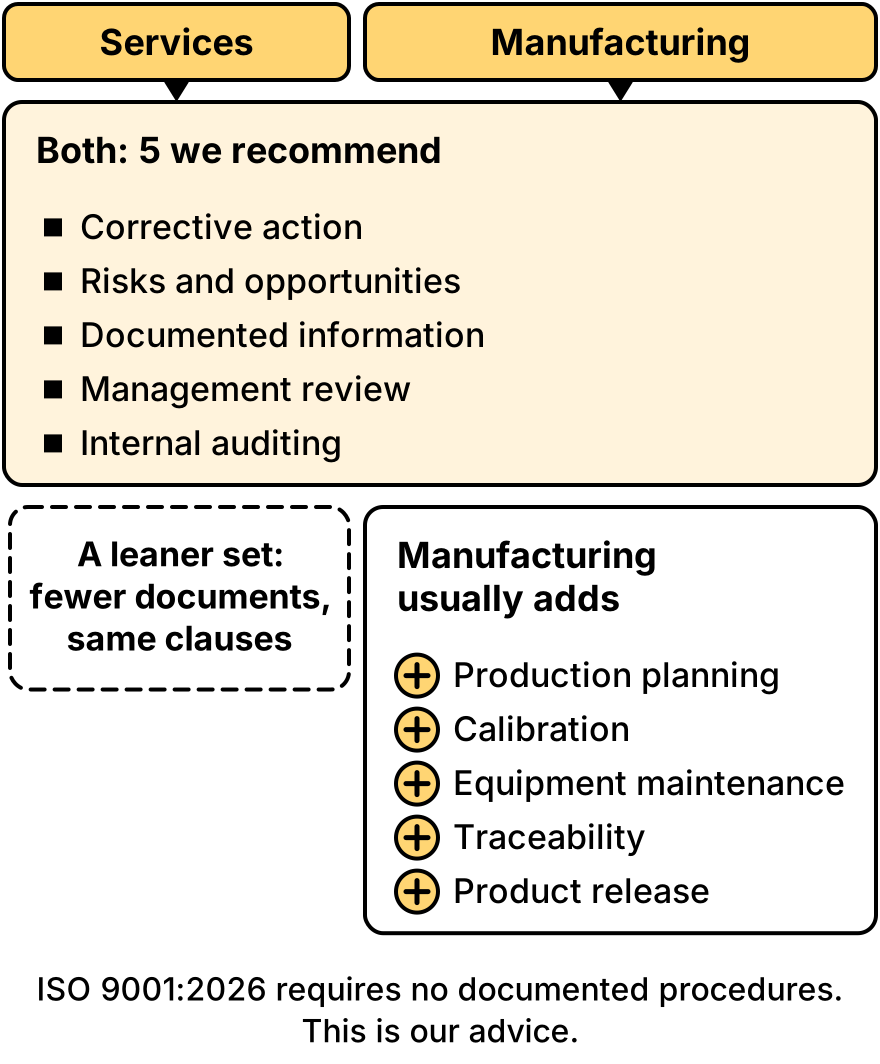
- Corrective action procedure
- Risks and opportunities procedure
- Documented information procedure
- Management review procedure
- Internal auditing procedure
It would be best to document your quality management system’s main operating procedures or processes.
Some Quality Manual Templates include more than 40 procedures — our advice is NOT to make life that complicated for yourself. The number of procedures you actually need depends on your industry, not a one-size-fits-all rule.
A service-based organization — consultancy, software, professional services, healthcare, finance — typically operates with a leaner set of procedures, because there are fewer physical production controls to document. A manufacturing organization generally needs additional procedures covering production planning, calibration, equipment maintenance, traceability, and product release.
Our ISO 9001 Quality Manual Template is offered in Services and Manufacturing variants for exactly this reason — each tailored to the controls typically expected in your industry. Both variants satisfy all ISO 9001:2026 requirements.

ISO 9001 Mandatory Documents FAQs
Is a quality manual mandatory in ISO 9001?
No. ISO 9001:2026 does not require a quality manual, and neither did ISO 9001:2015. Many organizations keep one anyway, because it gives auditors, customers and new staff one place to see how the whole system fits together.
Is a document control procedure mandatory?
No. You must control your documented information: its availability, protection, distribution, storage, version control, retention and disposal (7.5.3). You do not have to write a procedure for it. Most organizations do, because it is the simplest way to show an auditor how your document control works. To see what a finished procedure looks like, download our free ISO 9001 procedure samples.
What is the difference between a document and a record?
A document tells people what to do and is kept up to date. A policy or a procedure is a document. A record proves what was done and is protected from unintended changes. An audit report or a training record is a record. ISO 9001:2026 calls the first "available as documented information" and the second "available as evidence of".
How many documents does ISO 9001 require?
Five documents apply to every organization: the scope, process information, the quality policy, the quality objectives and the documented information your QMS needs. Two more apply in some cases. The standard also asks for 17 groups of records, some only if you carry out that activity. The number of mandatory procedures is zero.
Do we need to rewrite our documents for ISO 9001:2026?
Usually not. ISO 9001:2026 adds no mandatory procedure and no quality manual requirement. Review your documents against the changes (separate actions for risks and opportunities, quality culture and ethical behaviour, and planning of changes) and update any references to the 2015 edition. If you are starting a QMS from scratch in a small business, read our guide to QMS for small business.
