
What Is the QMS Documentation Pyramid?
QMS documentation structure is simply how you arrange the documents in your quality management system so that people can find the right one and know it is current. Most organizations use a four-level pyramid, with the quality manual and policy at the top, then procedures, then work instructions, and forms and records at the base. Each level answers a different question and points down to the detail beneath it. This guide explains the four levels, what ISO 9001:2026 does and does not require, and how to set the structure up in your own organization.
Contents
- The Four Levels of QMS Documents
- Does ISO 9001:2026 Require a Document Hierarchy?
- How to Structure QMS Documents for Your Organization
- Improving the Structure of an Existing System
- 5 Reasons to Use a Template to Build the Pyramid
- What a Template Set Should Include at Each Level
- Where Templates Can Go Wrong
- QMS Structure FAQs
The pyramid is simply a picture of how your QMS documents relate to each other. A handful of documents at the top set the direction for the whole business. The many documents at the base record what happened each day. Working down from the top, you move from why we do it, to who does what and when, to how each task is done, and finally to the evidence that it was done.
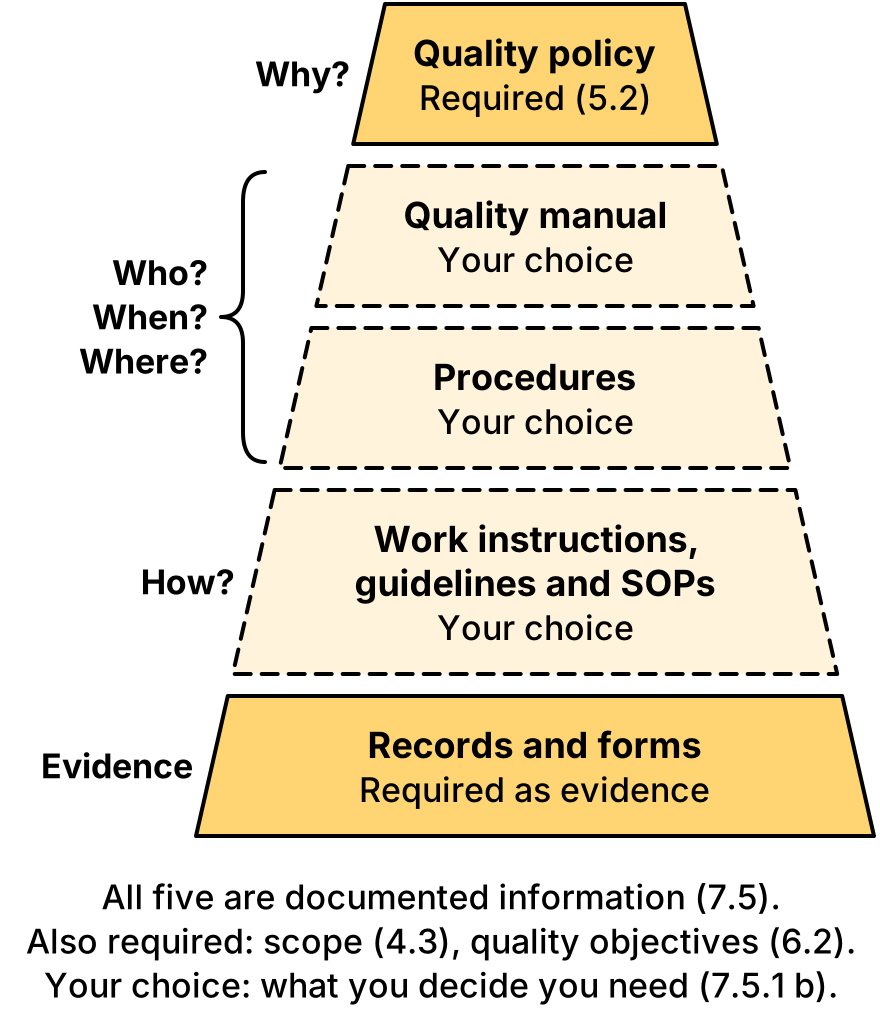
The diagram draws level 1 as two tiers, the quality policy at the peak and the quality manual beneath it, because ISO 9001 treats them differently. The policy is required; the manual is your choice.
The Four Levels of QMS Documents
Each level does a different job, is written for a different reader and changes at a different rate. The higher up the pyramid you go, the fewer documents there are and the less often they change.
Level 1: Quality Manual, Policy and Scope
Level 1 sets out what your quality management system is and why it exists. It holds the quality policy, the scope of the system and the quality objectives, plus a quality manual to tie them together if you choose to keep one. Top management owns this level. It rarely changes, usually only after a management review or a big change in the business.
ISO 9001:2026 requires the quality policy (5.2), the scope (4.3) and the quality objectives (6.2) to be available as documented information. It does not require a manual, but many organizations keep one because it gives auditors, new staff and customers one document that introduces the whole system. Our guide to the quality manual explains what to put in one.
Level 2: Procedures and Process Maps
Level 2 describes how each of your main processes runs. A procedure covers one process, such as purchasing, internal audit or corrective action, and says who is responsible, what starts the work, the steps in order and what gets recorded. A process map or turtle diagram shows the same process as a picture, with its inputs, outputs, resources and measures.
This is where you meet clause 4.4 in practice. ISO 9001:2026 asks for documented information "to the extent necessary" to support the operation of your processes and as evidence that they are carried out as planned. It does not name a single procedure, so how many you write is up to you. If you only need a few, you can buy individual ISO 9001 procedures.
Level 3: Work Instructions
Level 3 tells one person how to do one task, such as setting up a machine, running a test, packing an order or logging a customer call. Work instructions are written for the people doing the job, so keep them short and specific. Photos, checklists and screenshots often work better than paragraphs of text. A procedure says what happens across a process; a work instruction says exactly how one step of it is done.
Not every task needs one. The note to clause 7.5.1 says the extent of documented information can differ with the size of the organization, the complexity of its processes and the competence of its people. In plain terms, a trained and experienced team needs fewer written instructions than a new one.
Level 4: Forms and Records
Level 4 is the base of the pyramid and by far the biggest level. Forms are the blank templates, such as an audit checklist, a training log or a nonconformity report. Once a form has been filled in it becomes a record, and records are your evidence that a process ran as planned.
ISO 9001:2026 asks for documented information to be "available as evidence of" many things, from competence (7.2) to internal audit results (9.2) and the results of management review (9.3). Annex A explains that this wording means keeping objective evidence. In plain terms, that means records. Our guide to mandatory records lists the documents and records the standard names.

Does ISO 9001:2026 Require a Document Hierarchy?
No. ISO 9001:2026 requires the documented information it names, plus whatever else you decide your system needs to work (7.5.1). It does not set levels, a numbering scheme or a structure, and it does not require a quality manual or any documented procedure.
Annex A goes further. It says the clause structure of the standard is not meant to be a model for documenting your policies, objectives or processes, and that documentation is more useful when it uses the terms and processes your organization already has (A.2). If you want more guidance on documented information, the standard points you to ISO 10013.
So the pyramid is a convention, not a requirement. It has stuck because it works. Policy sits apart from method, and method sits apart from evidence, so each document is easier to control. If you learned ISO 9001 from an older edition you may remember a required quality manual and a set of named procedures. ISO 9001:2026 names neither. For what the standard does count as documented information, see what documented information is.

How to Structure QMS Documents for Your Organization
Start from your processes, not from the clauses of the standard. List the processes you run. Decide which of them need a procedure, which tasks need a work instruction, and which forms each process produces. Then build the structure around that list.
- Decide how many levels you need. A large manufacturer with several sites usually needs all four. A small business QMS can often manage with two or three, for example a short manual that holds the policy, scope and process descriptions, plus the forms and records.
- Use one numbering scheme. Give every document a reference that shows its level and its process, for example QM-01 for the manual, P-08 for a procedure, WI-08-03 for a work instruction under it and F-08-03 for its form. Clause 7.5.2 asks for appropriate identification and description, such as a title, date, author or reference number.
- Link down, not across. Each document should name the documents directly beneath it. The procedure lists its work instructions and forms, and each work instruction names the form it uses. When one document changes, those links tell you what else to check.
- Write each level for its reader. Policy for everyone, procedures for process owners, work instructions for the person actually doing the job.
- Control every level the same way. Review and approval, version control, access, storage, retention and disposition apply to all of them, from the manual to the last form.
Our guides to creating and updating documented information (7.5.2) and control of documented information (7.5.3) cover those rules in detail.

Improving the Structure of an Existing System
Many systems grow without a plan. A procedure gets written after an audit finding. A form gets copied and changed. A work instruction lives on one person's desktop. After a few years nobody is quite sure which version is current or where a rule is written down.
Signs your document hierarchy needs work:
- The same rule is written in two documents, and they disagree.
- Procedures carry step-by-step task detail that belongs in a work instruction.
- Forms exist that no procedure mentions, or procedures refer to forms nobody uses.
- Document numbers do not tell you the level or the process.
To fix it, list every document you have and assign each one to a level and a process. Then merge the duplicates, move detail down to the right level and retire anything nobody uses. If you keep obsolete versions, control them so they cannot be used by mistake. Templates help here too. Map your existing documents against a complete template set and the gaps show up quickly.

5 Reasons to Use a Template to Build the Pyramid
Building all four levels from a blank page is a long job, especially if you are doing it in-house without a consultant. A template set gives you the structure from day one, so your effort goes into making the documents yours. Our ISO 9001 documentation package has been updated to ISO 9001:2026 and covers every level.
1. Ease the Documentation Process
Documentation is one of the first jobs when you set up a QMS, and it is the one most people put off. Templates give you a written starting point at every level, so you are editing rather than staring at a blank page. And once your system is running, any new document you add will match the ones you already have.
2. Everything You Need Is Included
A good template set is built around the standard, so the documented information ISO 9001:2026 asks for is already there. You are not left wondering whether you have missed a required document, and you can get on with fitting the content to your business.
3. Set a Solid Foundation
A template set gives you a structure that already works. The levels, the numbering and the links between documents are decided before you start. If you already have a system, the templates give you a benchmark to restructure it against.
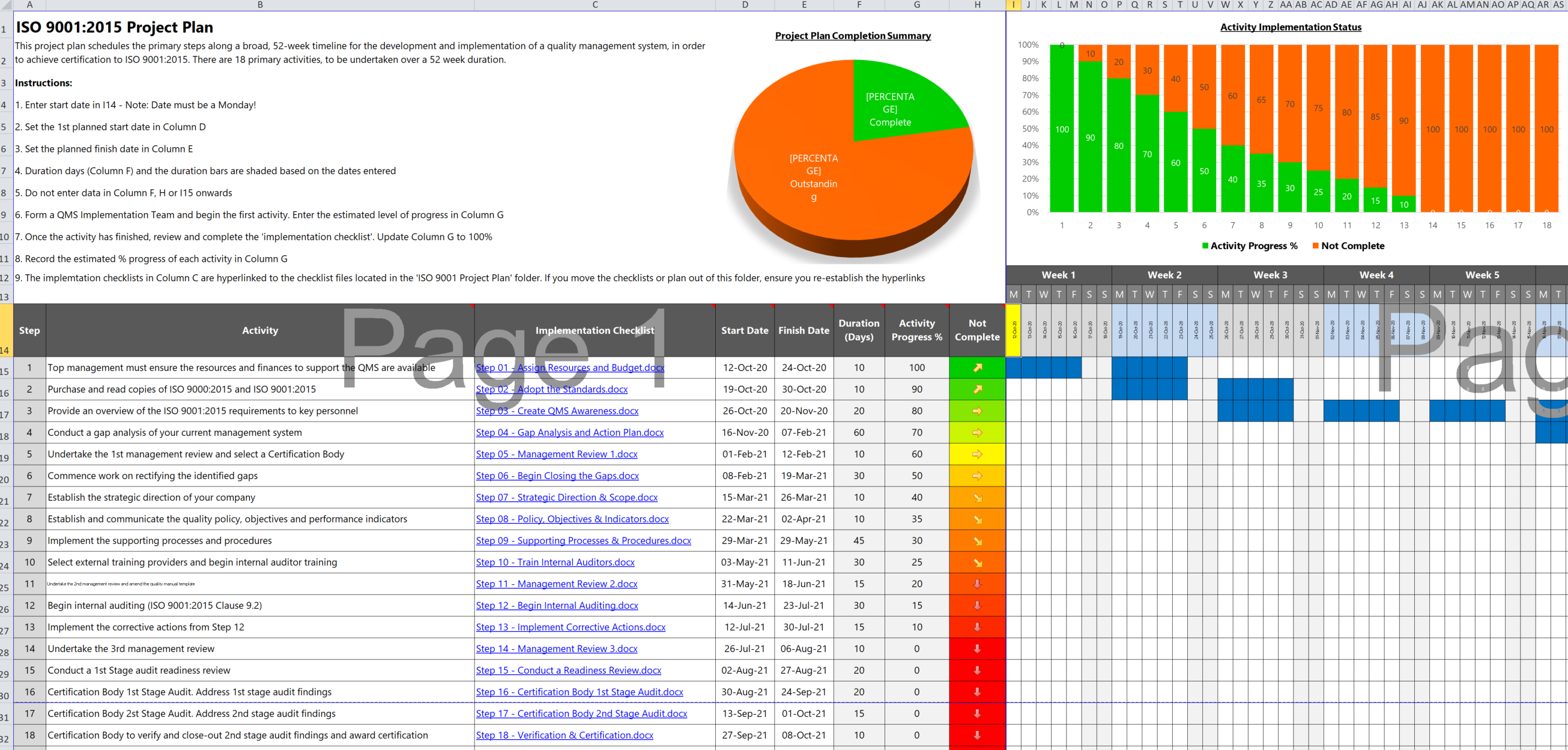
4. Easy to Follow Guidance, Project Plan
The best templates tell you where and how to customize each document, and they come with a project plan so you know what to do and in what order. Clear guidance also means that whoever picks up a document later will use it in the same way.
5. Proven Approach to Quality Management Systems
Templates written by people who have sat through a lot of audits carry those lessons with them. Ours are written by ISO auditors and quality manager trainers. You start with an approach that has already been tested, rather than discovering the weak spots at your certification audit.

What a Template Set Should Include at Each Level
When you compare template sets, check that every level of the pyramid is covered and not only the manual. This is what our ISO 9001 documentation package holds at each level:
- Level 1, manual, policy and scope: 1 quality manual, ready to edit with your policy, scope and objectives.
- Level 2, procedures and process maps: 28 procedures and 42 process maps and turtle diagrams.
- Level 3, work instructions: these are specific to your own tasks, so they are the documents you write yourself.
- Level 4, forms and records: 83 reports and forms.
Once the coverage is right, look for:
- Instructions: clear notes on how to customize each document.
- Simplicity: documents that are easy to edit and use, in Word and Excel.
- Efficiency: nothing your business does not need.
- Support: someone to contact if you get stuck while customizing.

Where Templates Can Go Wrong
Templates save a lot of time, but they are not problem-free. It helps to know where they go wrong.
Poorly made templates: a template that gets the standard wrong copies that mistake straight into your system. Review every document before you adopt it.
Templates that ignore the structure: a pile of unconnected documents is not a system. Check that the procedures, work instructions and forms refer to each other.
Hidden costs: some kits only make sense once you have paid for extra help later. Check what you are getting before you buy. You can look through our free sample documents first.
Too little customization: every template needs editing to match your processes, your terms and your branding. Your auditor will expect your documents to describe how your organization actually works.

QMS Structure FAQs
How many levels should a QMS have?
There is no required number. Four is the common convention: manual and policy, procedures, work instructions, and forms and records. Small organizations often combine levels and use two or three. Choose the fewest levels that keep each document clear and easy to control.
Is a work instruction a procedure?
No. A procedure describes a whole process: who does what, in what order and what is recorded. A work instruction describes how to carry out one task within that process, in enough detail for the person doing it. Both are documented information under ISO 9001:2026, and both are controlled the same way.
Where do process maps sit in the hierarchy?
At level 2, beside the procedures. A process map shows the same process as its procedure, drawn as a flowchart or a turtle diagram with inputs, outputs, resources and measures. Some organizations use a map instead of a written procedure for simple processes.
Do records need their own procedure?
No. ISO 9001:2026 does not require a procedure for records, or for anything else. It does require you to address the retention and disposition of documented information, and to protect documented information kept as evidence of conformity from unintended alterations (7.5.3). Many organizations write a short records procedure anyway, because it is the simplest way to show how they do that.

