
What is Improvement for ISO 14001:2026?
Your organization should actively seek out and realize improvement opportunities that will better enable it to achieve the intended outcomes of the EMS.
Contents


Why Reinvent The Wheel?

10.1 General
Improvement may not always take place on a continual basis. ‘Improvement’ can be affected:
- Reactively (e.g., by corrective action)
- Incrementally (e.g., by continual improvement)
- By step change (e.g., breakthrough)
- Creatively (e.g., innovation) or by
- Re-organization (e.g., transformation)
Potential sources of improvement opportunities include the results of analysis and evaluation of:
- Environmental performance
- Levels of compliance
- Internal auditing
- Management reviews
Your organization should actively seek out and realize improvement opportunities that will better enable it to achieve the intended outcomes of its EMS.
Look out for objective evidence that improvement is taking place. However, while improvement does not need to be continuous, it does need to be evidenced as occurring.

10.2 Nonconformances and Corrective Action
The organization is required to take whatever action is necessary to control and correct a nonconformity, and to deal with any resultant environmental impact.
Determine what caused the nonconformity and then to consider whether the potential for a similar problem remains. You will need to consider whether any further action is required to prevent a similar nonconformity recurring at the same place or occurring somewhere else, at some point in the future.
Auditors should evidence that where nonconformities have been identified an investigation has been conducted to determine whether other similar nonconformities actually do or potentially could exist and whether the organization has considered whether it needs to make changes to the EMS to prevent recurrence or occurrence elsewhere:
- Take whatever action is necessary to control and correct the nonconformity, and to deal with any resultant environmental impact
- Determine what caused the nonconformity and then to consider whether the potential for a similar problem remains
- Consider whether any further action is required to prevent a similar nonconformity recurring at the same place or occurring somewhere else, at some point in the future
- Determine if similar non-conformity has occurred elsewhere and consequently whether it needs to take similar corrective action
There may be instances where it is impossible to completely eliminate the cause of non-conformity, so in instances, the best organizations can do is to reduce the likelihood or the consequences of a similar occurrence happening again in order to reduce the risk to an acceptable level.
Dealing with Corrective Action
A corrective action should be considered as a reactive response to a problem since it is taken when a nonconformance is detected or upon receipt of a customer complaint.
Your organization should first contain the problem and then determine its root cause in order to take appropriate corrective action to prevent the problem’s recurrence.
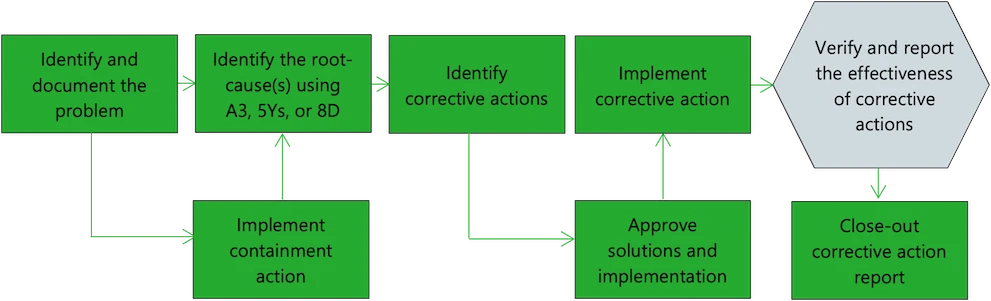
Corrective Action Process
- Define the Problem
- Select an Interim Containment Action (ICA)
- Verify an Interim Containment Action
- Implement an Interim Containment Action
- Identify the Root-Cause
- Complete a Comparative Analysis
- Develop Root-cause Theories
- Test the Theories
- Verify the Root-Cause
- Determine and Verify the Escape Point
- Implement & Validate Permanent Corrective Actions
- Prevent Recurrence
Looking For A Corrective Action Template?

10.3 Continual Improvement
Auditors should evidence whether your organization has identified improvement opportunities and EMS underperformance using the outputs from other processes such as, analysis and evaluation, internal audit, management reviews, tools and methodologies to support investigations. Auditors should also check whether the organization has implemented the identified opportunities for improvement in a controlled manner.
The standard provides help to interpret some terms used in this clause. ‘Continual’ means that this activity occurs over a period of time, but with potential intervals of interruption, while ‘continuous’ means duration without interruption.

Continual Improvement Process
Your organization should seek to implement a process, with appropriate methods, techniques, and formats for identifying areas of underperformance or opportunities for improvement.
You should expect to evidence that your organization has selected the appropriate tools and techniques to investigate the causes and thereby establishing and implementing a process for continual improvement.
The impetus for continual improvement must come from the use of (as a minimum):
- EMS Policies
- Risks and opportunities
- EMS objectives
- Aspect and impacts
- Hazards and safety risks
- Analysis and evaluation of data
- Audit results
- Management review
- Non-conformity and corrective action
Requirements for continual improvement interrelate with the following clauses:
- EMS planning
- EMS objectives
- Risks and opportunities
- Recommendations for improvement
- Improvement of the system, processes and products
- Analysis and evaluation of data
- Non-conformity and corrective action
Processes can always be made more efficient and effective, even when they are producing conforming products. The aim of a continual improvement program is to increase the odds of satisfying customers by identifying areas that need improvement. It requires the organization to plan improvement systems and to take into account many other activities that can be used in the improvement process.
You will be required to ensure that you continually improve the degree to which your products and services meet customer requirements and to measure effectiveness of your processes. To this end the continual improvement principle implies that you should adopt the attitude that improvement is always possible and your organizations should develop the skills and tools necessary to drive improvement.

Once your environmental management system has been implemented, run the new EMS for at least three months to ensure it is fully embedded it into your business’s processes and to identify nonconformities, address corrective actions, and to implement any improvement opportunities. Engage with your chosen Certification body to arrange certification.

Related Information You Might Find Useful
- ISO 14001 Continual Improvement Survey
- 10.3 Continual Improvement [ISO 9001]
- 10 Improvement [ISO 45001
- iso.org ISO14001:2015 Auditing Practices Group Guidance on Improvement


 Process Maps
 Corrective Action Tracker
 Charts
 Reports & Forms
 User Guides
 Training


