
What is Understanding the Organization and its Context for ISO 14001?
The organization is required to understand the internal and external issues that apply to your organization and are relevant to the achievement of the EMS objectives.
To be compliant, evidence should be obtained that demonstrates that your organization is reviewing all pertinent internal and external pressures at periodic intervals.
Contents
- What is Understanding the Organization and its Context?
- Purpose
- Application & Scope
- Where Do Variables in Organizational Context Arise From?
- Internal and External Issues
- Objective Evidence
- Examples of Organizational Issues Relating to the EMS
- Methodologies to Understanding Issues
- Example ISO 14001 Risk Register
- Other Methods to Review your Business's Context
- Context of the Organization Procedure

Purpose
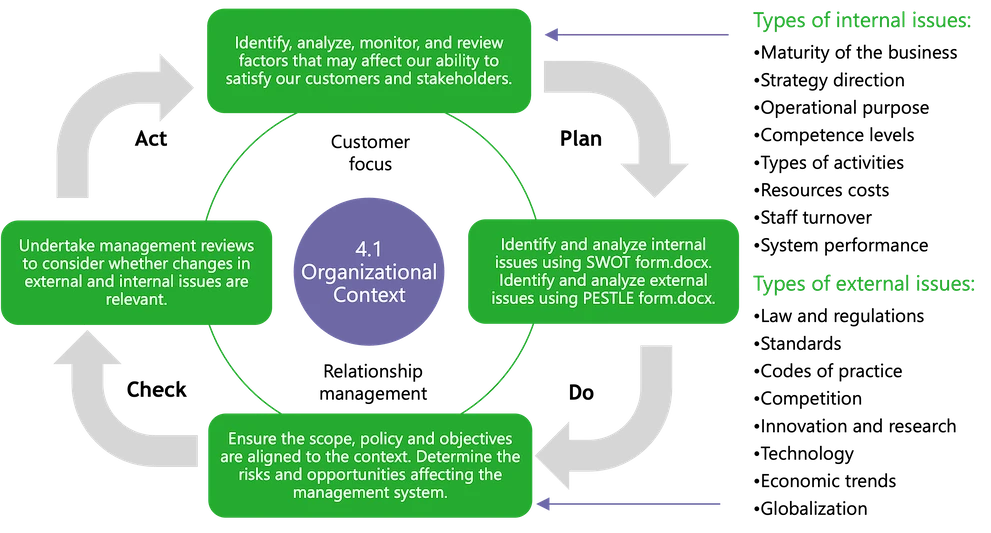
The purpose of this procedure is to outline your organization’s process for the identification and determination of internal and external issues, interested party requirements, management system scope, and processes that relate to our environmental management system, and which influence our strategic direction (where we’re going) and our operational purpose (what we make and do).
Application & Scope
As a prerequisite for risk-based thinking and evidence-based decision-making, define the levels of risk and criteria related to your organization’s internal and external issues, interested party requirements, and environmental management system scope and processes. Issues include but are not limited to:
- Applicable laws
- Market and market trends
- Competitors including technology
- Customers and end users
- Policy, objectives, strategies
- Promising business opportunities
- Personnel qualifications
- Management review inputs
Your organization’s approach to planning the environmental management system comprises a set of iterative steps as described below.
Don’t Try to Manage It All Alone!

Where Do Variables in Organizational Context Arise From?
- The products and services delivered to meet customer needs
- Financial resources available
- Personnel
- The location of activities
- The activities and processes undertaken
- The strategic vision for the company
- The customer and supplier base
The implementation of an EMS is often a strategic decision that is influenced by the context of the organization. The consideration of contextual issues ensures that all internal and external priorities that can impact the strategic objectives, processes, and the outcomes of the EMS are considered.
Internal and External Issues
- What is happening within the economy?
- What is happening politically in the environment in which we operate?
- What is happening with changes to legislation?
- What is happening with respect to ecological and environmental issues?
- What is happening technology-wise which can impact what we do?
- What is occurring socially and culturally in the markets in which we operate?

Objective Evidence
Objective evidence should be documented to provide assurance that your business regularly, or as necessary, reviews and updates its list of external and internal issues.
Sources of Objective Evidence might include:
- Business Strategy Plans
- Environmental Plans
- Competitor Analysis
- Annual reports and economic reports from business sectors, or consultant’s reports
- SWOT Analysis techniques for identifying internal issues
- PESTLE Analysis techniques for identifying external issues
- List of external and internal environmental issues and conditions
- EMS Action Plans and Objectives
- Management meeting minutes
- Annual Reports
A workshop approach often allows ideas to be shared and provides an effective and efficient way of achieving a valuable outcome. The workshop could be a discussion identifying the issues that can be mapped out using Political, Economic, Social, Technological, Legal, and Environmental (PESTLE) analysis. This method helps to structure the conversation and will also help to achieve buy-in to what is often seen as a peripheral or niche area
Examples of Organizational Issues Relating to the EMS
- Environmental conditions can affect or be affected by the organization. Examples include the impacts of climate change, storms and floods, air quality, water quality, land use, existing contamination, natural resource availability, biodiversity, etc.
- Internal issues: organization’s activities, products, services, strategic direction and capabilities (people, knowledge, processes, systems)
- External issues: cultural, social, political, regulatory, financial, economic, natural and competitive issues, whether international, national, regional or local
Consider different levels of the organization.
For multi-site/multi-business organizations, consider the need to determine internal and external issues at the corporate level before cascading this to facilities/businesses to identify internal and external issues.

Methodologies for Understanding Issues
Many organizations already have formal or informal methodologies for determining their internal and external issues, such as corporate or enterprise risk management systems or horizon scanning as part of strategic planning.
Gather input from different functions of the organization and internal stakeholders who can provide an understanding of different topic areas. This will ensure that the understanding gained covers the broadest possible scope. This could be achieved through interviews, meetings or workshops.
Identify the internal and external issues related to the context. Issues can be identified by structuring them by topic. One methodology is the political, economic, social, technological, legal and environmental (PESTLE) analysis.
Consider the risks and opportunities associated with these internal and external issues. Although this is a requirement of ISO 14001:2015 clause 6.1.1, it can be intuitive to determine risks and opportunities as part of the same process that identifies the issues.
Example ISO 14001 Risk Register
These risks and opportunities can be transferred to a more formal risk register for quantitative assessment and tracking.
| Theme | External Issues | Internal Issues | Risks & Opportunities |
|---|---|---|---|
| Political |
|
|
|
| Economic |
|
|
|
| Social |
|
|
|
| Technological |
|
|
|
| Legal |
|
|
|
| Environment |
|
|
|
Other Methods to Review Your Business's Context
- Interviews with members of the Top Management team
- Staff questionnaires
- Customer and stakeholder opinion surveys or research
Cross-functional input is essential for the specific expertise required to identify the full breadth of issues, such as finance, training, human resources, commercial, engineering and design, etc.
Not only will this ensure a broader appreciation of the context but also wider engagement, particularly with those functions not previously involved with the EMS.

Related Information You Might Find Useful
- 4.1 Understanding Context of the Organization [ISO 9001]
- 4.1 Understanding the Organization and its Context [ISO 45001]
- www.nesi.org 4.1 Understanding the Organization and its Context
 ISO 14001
 Process Maps
 Reports & Forms


