What is Nonconformance & Corrective Action for ISO 45001?
Taking appropriate action to address the effects of a nonconformity may require a simple correction by the process owner or operator where it was discovered. If a major failure or defect exists, more significant resources would be needed for problem-solving and corrective action.
Contents

Identifying Nonconformities
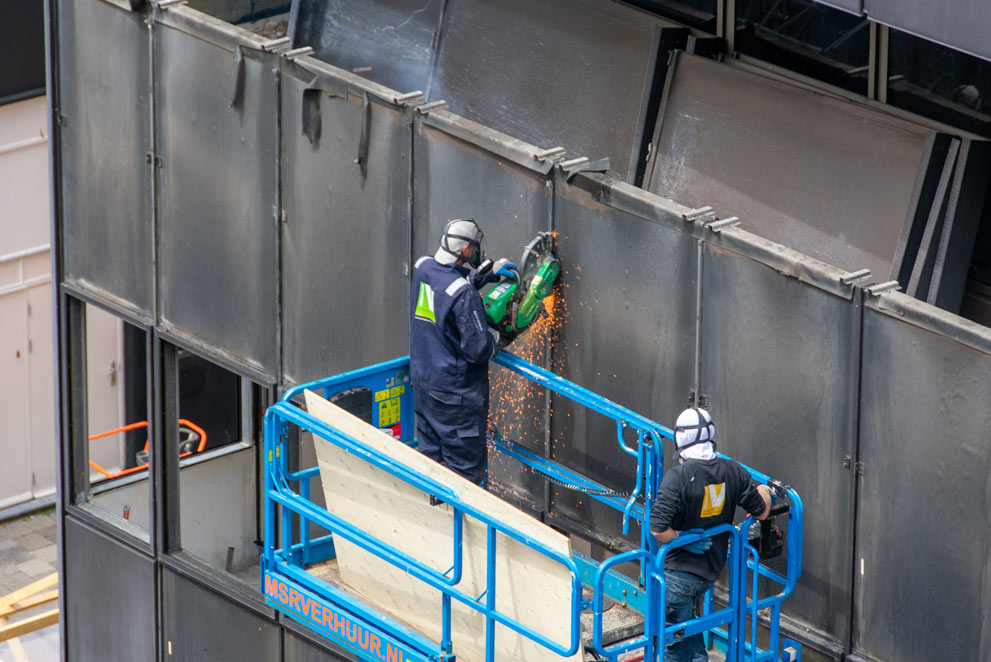
Nonconformities can be identified during any number of activities, including:
- Risk assessment and review
- Monitoring and measurement activities
- Routine supervisory inspections
- Failure to wear personal protective equipment
- Failure to report defective plant or machinery
- Training record not available
- No maintenance schedule provided for extraction system
- Complaint
- Leaking oil from compressor on floor
- No MSDS for a chemical available
- Non-compliance with a license condition
- Reviews, examinations, inspections and audits
Looking For a Non-Conformance Procedure?

What to Do With a Nonconformity?
Recommendations should be recorded and actioned as appropriate, whether emanating from audits, assessments, hazard reports, or incidents. In most cases, the recommendations must be actioned at the source but recorded, as this will facilitate statistical analysis as we advance.
Other recommendations must be assigned to appropriate personnel with a target date and tracked for completion by the Health and Safety Department.
Appropriate personnel may usually be Line Management, who may delegate actions but will report back to the Health and Safety Department upon completion, depending on the nature of the findings.
Changes to the OH&S Management System must recorded, as must all document changes. Recommendations will then be fed back into the system, which can be updated and used for future training.
The Health and Safety Department should track incidents every month. However, serious safety issues must be addressed immediately.
Senior Management must review the progress on any outstanding recommendations and take the necessary action to expedite completion.
There may be instances where it is impossible to completely eliminate the cause of nonconformity. In these cases, the best organizations can do is reduce the likelihood or consequences of a similar occurrence happening again to reduce the risk to an acceptable level.
Corrective action should be considered a reactive response to a problem since it is taken when a nonconformance is detected or upon receipt of a customer complaint.
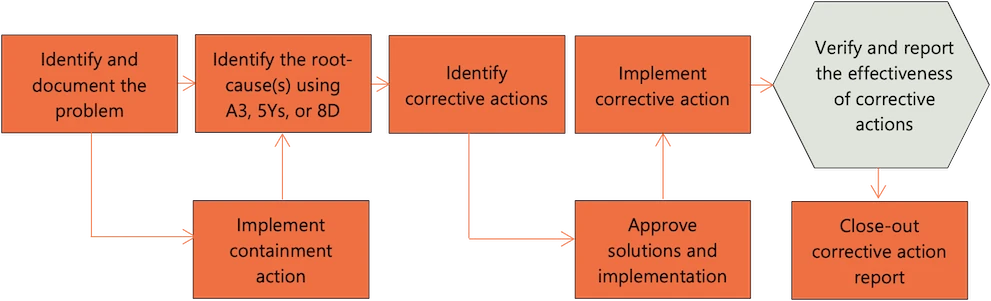
Step 1: Define the Problem and Select Interim Containment Action
The problem description should describe the problems in terms of what, where, when, and how big.
The description should contain facts, such as observations and documentary evidence, not assumptions.
All information must be gathered before identifying the root-cause can begin. Ensure both of the above factors are true before moving to the next step. Consider any new information the team may have gathered since completing the initial problem description.
Define, verify, and implement the interim containment action to isolate the problem's effects from any internal or external customer until permanent corrective actions (PCA) are implemented. Validate the effectiveness of the containment actions.
An interim containment action is kept in place until a verified permanent corrective action can be implemented. In some cases, the interim containment action may be the same as or similar to the emergency response action. However, an emergency response action is implemented with minimal supporting data. An interim containment action provides more opportunity for investigation.
Any interim containment action you implement must protect the customer from the problem without introducing new problems. Also, a single interim containment action may not be enough. You may need to implement more than one interim containment action to protect the customer entirely.
An interim containment action can be any action that protects the customer from the problem. However, before you implement an interim containment action, you need to verify that the interim containment action will work.
To Verify the Interim Containment Action:
- Prove before implementation it protects the customer from the problem
- Provide a before-and-after comparison
- Prove that the interim containment action will not introduce any new problems
Methods of Verification may Include:
- A test to determine the desired performance level
- A demonstration that changes eliminated the issue without creating a new problem
- A comparison between the interim containment action and similar proven actions
- A review to evaluate whether the interim containment action was effective
- Assurance that the interim containment action did not introduce a new problem
Conduct trial runs whenever possible. However, in some situations, your verification may be a matter of common sense. For example, if an interim containment action involves stopping the shipment of all products, you can be sure that customers will stop experiencing the problem.
Looking For a Corrective Action Procedure?
Implementing the Action
You and your team must consider all trade-offs connected to your interim containment action. An essential part of implementing an interim containment action is planning how you will implement the action.
To Implement An Interim Containment Action, Follow This Management Cycle:
- Plan (Re-plan)
- Do (Implement)
- Check (Monitor)
- Act (Evaluate)

Step 2: Identify the Root-cause
Isolate and verify the root cause by testing each possible cause against the problem description and test data. Also, isolate and verify the place in the process where the effect of the root cause should have been detected and contained (escape point).
Root-cause analysis (RCA) is a problem-solving method class that identifies the root causes of problems or events. The practice of RCA is predicated on the belief that the issues are best solved by attempting to correct or eliminate root causes instead of merely addressing the immediately obvious symptom. By directing corrective measures at root causes, it is hoped that the likelihood of problem recurrence will be minimized.
The General Principles Of Root-cause Analysis Include:
1. Aiming performance improvement measures at root causes is more effective than merely treating the symptoms of a problem.
2. RCA must be performed systematically, with conclusions and causes backed up by documented evidence to be effective.
3. There is usually more than one root cause for any given problem.
4. For the analysis to be effective, it must establish all known causal relationships between the root cause (s) and the defined problem.

General Process for Performing and Documenting an RCA-based Corrective Action
Notice that RCA (in steps 3, 4, and 5) is the most critical part of successful corrective action because it directs the corrective action at the root of the problem. That is to say, we seek effective solutions, not root causes.
Root causes are secondary to the goal of prevention and are only revealed after we decide which solutions to implement.
- Define the problem
- Gather data/evidence
- Ask why and identify the causal relationships associated with the defined problem
- Identify which causes, if removed or changed, will prevent recurrence
- Identify practical solutions that prevent recurrence, are within your control, meet your goals and objectives, and do not cause other problems
- Implement the recommendations
- Observe the recommended solutions to ensure effectiveness
Examples of Root-cause Analysis Techniques Include:
- 5-Whys
- Failure mode and effects analysis
- Pareto analysis
- Fault tree analysis
- Cause Mapping - A problem-solving method that draws out, visually, the multiple chains of interconnecting causes that lead to an incident
- Barrier analysis - a technique often used in, particularly in process industries
- Change analysis - an investigation technique often used for problems or incidents
Don’t Try to Manage It All Alone!

Basic Elements of Root-causes Include:
- Materials
- Defective raw material
- Wrong type for job
- Lack of raw material
- Machine/Equipment
- Incorrect tool selection
- Poor maintenance or design
- Poor equipment or tool placement
- Defective equipment or tool
- Environment
- Orderly workplace
- Job design or layout of work
- Surfaces poorly maintained
- Physical demands of the task
- Forces of nature
- Management
- No or poor management involvement
- Inattention to task
- Task hazards not guarded properly
- Other (horseplay, inattention)
- Stress demands
- Methods
- No or poor procedures
- Practices are not the same as written procedures
- Poor communication
- Management system failure
- Training or education lacking
- Poor employee involvement
- Poor recognition of hazard
- Previously identified hazards were not eliminated
To validate those potential root-causes that are under your control, you can apply the following validations to your answers or root-causes.

The 5 Whys
Ask the following questions for every possible root-cause you identify at all levels of the 5 Whys:
- It there any proof (something you can measure or observe) to support this root-cause determination?
- Is there any history or knowledge to indicate that the possible root-cause could actually produce such a problem?
- Is there anything “underneath” the possible root-cause that could be a more probable root-cause?
- Is there anything that this possible root-cause requires in order to produce the problem?
- Are there any other causes that could possibly produce the same problem?
Example 1 - Nonconformance:
'Components are being delivered late to our customers'
Why 1 - Why were we unable to meet the agreed-upon timeline or schedule for delivery? The job took much longer than we thought it would
Why 2 - Why did it take so much longer? Because we under estimated the complexity of the job
Why 3 - Why did we underestimate the complexity of the job? Because we made a quick estimate of the time needed to complete it, and did not list the individual stages needed to complete the project
Why 4 - Why didn't we do this? Because we were running behind on other projects
Why 5 and Root-cause - Why are we running behind on other projects? We do not allow enough manufacturing/lead time when issuing quotations to our clients.
Example 2 - Nonconformance:
'The CNC machine keeps failing'
Why 1 - Why did the equipment fail? Because the circuit board burnt out
Why 2 - Why did the circuit board burn out? Because it overheated
Why 3 - Why did it overheat? Because it wasn’t getting enough air
Why 4 - Why was it not getting enough air? Because the filter wasn’t changed
Why 5 and Root-cause - Why was the filter not changed? Because there was no preventive maintenance schedule in place informing the operator to do so.

Comparative Analysis
Once you have reviewed the problem description, you can begin a comparative analysis. A comparative analysis will help you identify relevant changes in a change-induced situation.
Then you can reduce the number of possibilities that you must consider to determine root-cause.
To Complete a Comparative Analysis:
- Ask yourself; what is unique, peculiar, different, or unusual about the symptoms?
- Consider features such as people, processes, materials, machines and the environment
- List all facts without prejudice as to the possible cause
Consider each difference you listed, and look for changes, ask yourself:
- What has changed to give rise to this difference?
- Keep in mind that each difference may not have a corresponding change
- List the changes next to the difference
- Look at the dates each change occurred
- Eliminate some changes if they occurred after the problem started
- Consider categories of people, machines, processes or measurements
If the problem is change-induced, the root-cause must be the result of a change relative to one or more of the identified changes. It is important to remember that you have not yet moved from the ‘observations’ phase of the process.
Any information you develop during the comparative analysis must be fact-based, not opinion-based, and must be true only for the symptom’s information. Do not rule out any facts that might be valid answers.
If it is a fact and it answers the question, write it down.

Step 3: Develop Root-cause Theories
Now that you have narrowed down the possible root-causes, you need to develop theories about how the problem occurred. Theories are statements that describe how a change may have created the problem.
To Develop Root-cause Theories:
- Use brainstorming techniques to generate ideas
- Ask: ‘How could this change have caused the problem?’
- Continue to ask the question until all possible theories are developed
- List at least one theory for each change
- List each theory individually on a worksheet
- List every possibility, no matter how strange or unlikely
- Don't reject or qualify any theory
- Start with the most straightforward single change theory first
- Then, work up to more complex theories
- Be specific; don't use generalities such as ‘poor quality’ or ‘doesn't work’
To test the theory, do the following:
- Ask, ‘Does this theory explain the symptoms and data, if so how?
- Test the theory against each individual condition
If a theory explains the problem but lacks the information necessary to explain why it happened, gather more data:
- Gather more data to prove or disprove these theories
- Test simple (single change) theories first
- Test highly complex or interactive theories last
The Root-cause Must Explain ALL Known Data
Any theories that pass the trial run are the most likely causes. If only one theory passes the trial run, then verify this theory as the root-cause. However, more than one theory may pass the trial run. In those cases (and when practical and feasible), collect and analyze any missing data for uncertain theories and re-examine information to resolve uncertainties.
If additional information reveals that a theory cannot fully explain why the problem happened, eliminate it from consideration.
If gathering and evaluating additional information is not feasible, try to verify each remaining theory. Start verification with the theory that best explains the symptoms.
Start with Expert Templates, then Make Them Yours

Verification
Once you have determined the most likely cause(s), verify that it actually causes the problem. Verification is proof to confirm that you have identified the root cause. It can be done passively or actively.
Passive Verification
Passive verification is done by observation:
- Look for the presence of the root-cause without changing anything
- If you cannot prove the root-cause, then the identified cause is not the root-cause
Active Verification
Active verification is done by manipulating the root-cause variable:
- Implement and remove the root-cause variable to make the problem ‘come and go’
- Both ‘coming’ and ‘going’ are essential tests to confirm the root-cause
- There can be more than one verified root-cause
Escape Point
After you have determined and verified the root-cause, you need to determine the escape point of the problem. An escape point is closest to the root-cause at which the problem could have been detected but was not.
Control System
A control system monitors the product/process and ensures compliance with health and safety requirements.
A Control System Consists Of:
- Responsibilities
- Procedures
- Resources
A control point is a location within the control system where the product/process is checked for compliance with health and safety standards.
A product or process may have more than one control point within the system. When you identify the escape point, you can work to improve or establish a system to ensure that if problems occur, they will not go undetected.
To Understand how the Problem Escaped and to Identify the Escape Point:
- Review the process; focus on the part of the process where the root-cause occurred
- Determine if a control system exists to detect the problem
If none exists, developing a new control system must be considered as part of the problem solution.
If a Control System Currently Exists:
- Identify the control point closest to the root-cause
- Determine if the control point is capable of detecting the problem
If the control system is not capable, developing an improved system must be part of the problem solution. If the control point is capable of detecting the problem, then the control point is the verified escape point. Choose and verify permanent corrective actions for the root cause and the escape point.

Permanent Corrective Actions
Select the best permanent corrective action to remove the root cause and eliminate the escape point.
Verify that both decisions will be successful when implemented without causing undesirable effects.
Steps for Permanent Corrective Actions (PCA) Selection:
- Establish decision criteria, e.g.; what is feasible
- Identify possible actions
- Choose the most appropriate permanent corrective action (PCA)
- Test and verify the permanent corrective action
- Re-evaluate the ICA & PCA for the escape point
Why Reinvent The Wheel?

Step 4: Implement and Validate Permanent Corrective Actions
Plan and implement selected permanent corrective actions. Remove the interim containment action and monitor the long-term results.
Steps for PCA implementation:
- Develop an Action Plan for PCA
- Implement the PCA Plan
- Remove the ICA
- Evaluate the PCA for the escape point
- Perform validation
- Confirm with the customer that the symptom has been eliminated

Step 5: Prevent Recurrence
Modify the necessary systems, policies, practices and procedures to prevent recurrence of this problem and similar ones.
Make recommendations for systemic improvements as necessary:
- Review the history of the problem
- Analyze how the problem occurred and escaped
- Identify affected parties
- Identify opportunities for similar problems to occur and escape
- Identify practices and procedures that allowed the problem to occur
- Identify practices/procedures that allowed the problem to escape to the customer
- Analyze how similar problems could be addressed
- Identify and choose appropriate preventive actions
- Verify preventive action and its effectiveness
- Develop action plan
- Implement preventive actions
- Present systemic preventive recommendations to the process owner
Serious consequences may occur when the underlying symptoms are not addressed when the quick fix is accepted as a final, permanent solution.
Excessive reliance on containment or emergency response action will create a repeating cycle.
Problem containment is an addiction that will only get worse until root-causes are found and addressed.

Related Information You Might Find Useful
- 10.2 What is Conformity in ISO 9001? [ISO 9001]
- What is Non-conformance in ISO 9001? [ISO 9001]
- 10.2 Corrective Action [ISO 9001]

 ISO 45001
 Nonconformity & Corrective Action Procedure
 Process Maps
 Corrective Action Tracker
 Charts
 Reports & Forms
 Guidance


