
6.1.1 General
ISO 14001:2015 requires organizations to consider risks and opportunities related to internal and external issues, environmental aspects and compliance obligations, which may themselves be sources of risk or opportunity. Section 6.1 requires an organization to maintain documented information of the process(es) needed in 6.1.1 to 6.1.4, to the extent necessary to have confidence they are carried out as planned.
Contents


Purpose
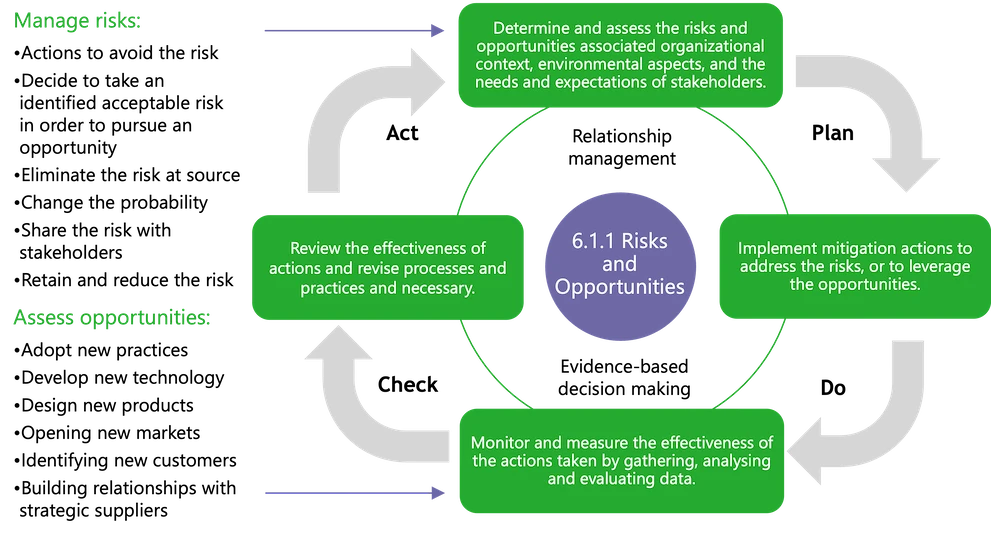
This procedure outlines your organization's risk and opportunity management framework and activities. The framework defines our current risk management process, which includes defining risk criteria, identifying, assessing, evaluating, prioritizing and communicating actions to mitigate risks or leverage opportunities.
Application & Scope
Your organization defines risk and opportunities as 'something happening that may impact achieving your objectives or the environmental management system.' Risk and opportunity management is central to our organization's strategic management.
It is the process by which management teams and risk owners methodically address the risks and opportunities attached to their activities to achieve sustained benefits.
Documentation
Documentation for clause 6.1 identifies, outlines, and acknowledges the company's environmental risks and any opportunities it may encounter.
These would include any abnormal risks and all and any emergency situations that may arise.
It also needs to show any opportunities the company may face to make any positive environmental changes or impacts.
The ISO 14001 standard does not prescribe a particular risk process or methodology to be documented; however, the onus is placed on the company to demonstrate a sound risk-based system is being followed.
The system the company follows should be easily explainable.
Approach
- The approach should be evidence-based, auditable documentation provided along with a sound and viable operational plan
- Link the policy to the various ISO 14001 clauses to assist in the analysis when needed
- Review any existing environmental aspect evaluation processes so that an identification of risks and opportunities is undertaken for each environmental aspect and related compliance obligation
- Determine the environmental aspects of activities, products and services, and their environmental impacts, considering a life cycle perspective
- Ensure the process for determining which interested party needs and expectations become compliance obligations is based on risks and opportunities
- Identify risks and opportunities that need to be addressed in relation to internal and external issues
- Establish environmental objectives at relevant functions and levels
Undertake a SWOT analysis as part of your organization’s business strategy to identify the external risks and opportunities, and plan actions to address them. A formal business risk assessment performed by your organization should take into consideration its context, associated risks and opportunities and mitigation plan.
Using the process approach, identify sources of input, activities, output, receiver of output, performance indicators to control and monitor processes, the associated risks and opportunities, and action plan to address them.
Why Reinvent The Wheel?

Outcomes and Options Include
- Avoiding the risk
- Taking risk in order to pursue an opportunity
- Eliminating the risk source
- Changing the likelihood or consequences
- Sharing the risk with stakeholder
- Retaining risk by informed decision

6.1.2 Environmental Aspects
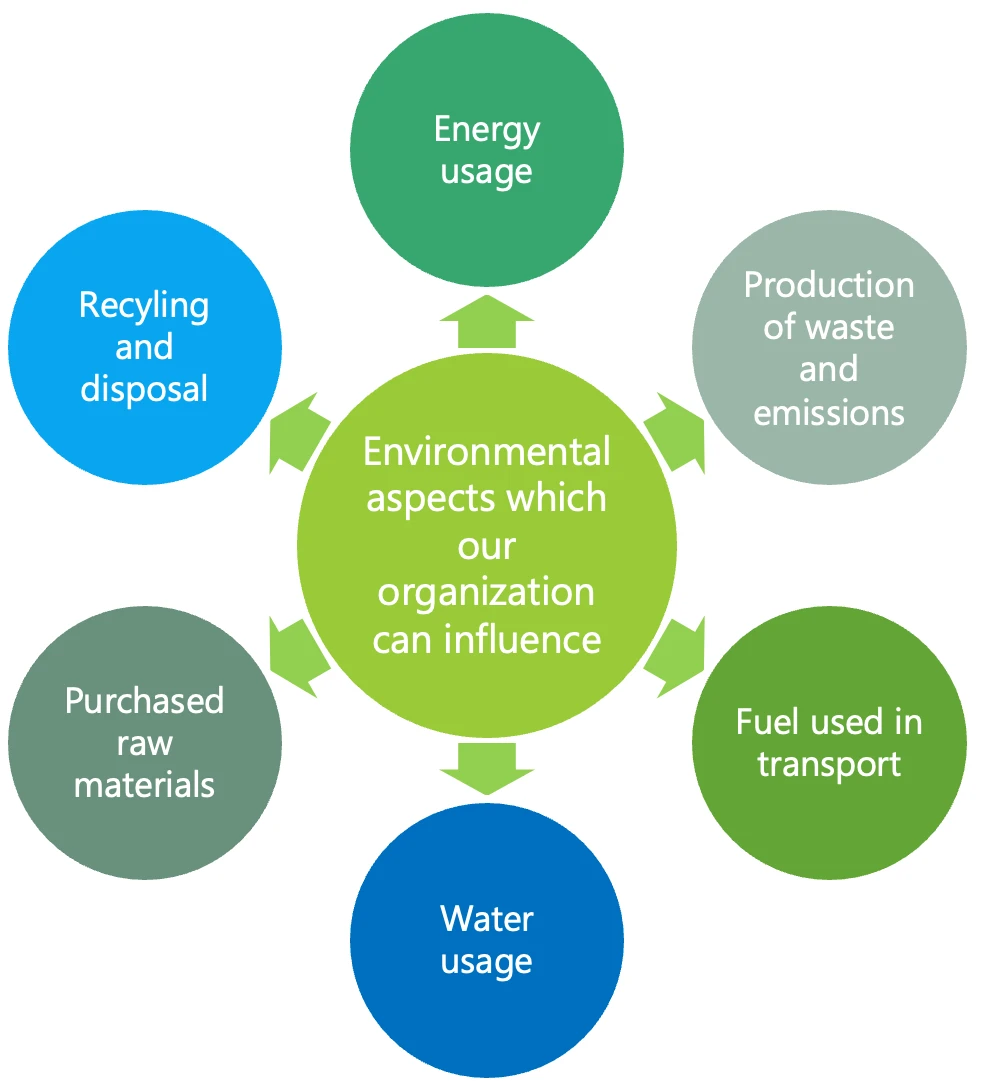
The organization has to determine the environmental aspects and the impacts of your activities, products and services that are under its control and influence.
Your organization should establish criteria to determine which of these aspects have or can have a significant environmental impact.
- Environmental Aspect – ‘is an element of your organization’s activities, products or services that interacts or can interact with the environment’.
- Environmental Impact – ‘changes to the environment, whether adverse or beneficial, wholly or partly resulting from your organization’s environmental aspects’.
- Significant Environmental Aspects can result in risks and opportunities that are associated with adverse or beneficial impacts. Objective evidence must contain established criteria for evaluating the significance of aspects (e.g., quantitative process or qualitative procedure).
Examples of Environmental Aspects
- Emissions to air via smoke or fumes
- Waste water discharge
- The potential for accidental chemical spill
- The generation of waste and disposal of waste
- The use of resources, including water and energy
- The use of recycled materials
- Noise and vibration
A cause-and-effect relationship exists between environmental aspects and environmental impacts, respectively. For instance, an environmental aspect, or cause, can be the emission of volatile organic compounds. The environmental impact, or effect; is ozone depletion.
Don’t Try to Manage It All Alone!

Five Actions for Compliance
To comply with ISO 14001 Section 6.1.2, the following five actions should be undertaken:
- Identify all of your organization's activities, products and services
- Identify the environmental aspects of all activities, products and services that can be controlled or influenced
- Identify the environmental impact(s) of each aspect
- Establish and maintain a procedure or method to identify any new or modified environment aspect or impact
- Identify the most significant environmental impacts
The identification of environmental aspects will form the foundation of your environmental management system. The operational aspects that have significant impacts on the environment should become the basis for your organization's development of appropriate objectives and targets; therefore, you should be thorough when completing this step.
Environmental Impacts – Objective Evidence Matrix Example
| Aspect | Impact | Activities | Objective | Target |
|---|---|---|---|---|
| Energy usage | Low volume usage | Site-wide | Ensure no increase | No increase above 50 kW/Pa |
| Use of VOCs | High volume usage | Fabrication | Reduce volume of VOC usage by using alternatives | Reduction of VOCs use by 50% |
| Contaminated scrap | High volume | Fabrication | Segregate contaminants from other scrap | Reduce by 20% |
| Exhaust emissions | Co2 emissions | Delivery/Transport | Drivers to turn off engine when static | Reduce by 10% |
Objective evidence must contain established criteria for evaluating the significance of environmental aspects; perhaps using an Excel workbook, ideally with formulae for calculating significance.

6.1.3 Compliance Obligations
Compliance obligations will arise from mandatory requirements, which include, for example, applicable laws that require permits and regulations that apply to the environmental aspects of your business’s activities, products and services and their associated environmental impact.
Voluntary commitments might arise from organizational and industry standards, supply chain relationships, commitments established in contracts and product specifications, principles of good governance, community relations, and ethical standards. Both voluntary and mandatory compliance obligations can result in risks and opportunities to the way you do business.
Documented information could be a list or matrix of compliance obligations:
| Environmental Aspect | Compliance Obligation | Risks | Opportunities | |
| Mandatory | Voluntary | |||
| Using f-gases in air conditioning units | The Fluorinated Greenhouse Gases Regulations 2009 | Annual sustainability and corporate responsibility reporting | Compliance with emission limits | Restrict hazardous substances in specifications |
| Disposal of waste batteries | Waste Batteries and Accumulators Regulations 2009 | Adopt a community environmental recycling project | Time and resources | Positive publicity |
| Generation of waste | Control of Pollution Act (COPA) 1974 | Agreement to meet a packaging reduction target | Licence/permit compliance and reporting | Increased revenue from waste recovery and recycling approaches |
In order to document your organization’s compliance obligations, you could use an Excel workbook comprising an indexed list of relevant legal requirements, and other obligations.
Other obligations might include standards and procedures for operational tasks and associated hazards, referencing the minimum acceptable legal, industry standards and technical specifications against the associated equipment and operating routines at your facility.
Information in the compliance obligations register for each requirement includes but is not limited to:
- Interested parties and their environmental needs and expectations
- Title and description of the related legal requirement
- Description of how the legal requirement applies and whether relevant licenses or approvals are required
- The related risks, opportunities and mitigation actions
- The title and description of supporting documents that demonstrate compliance
- How compliance is verified
The compliance obligations register must be reviewed and updated for adequacy, both for new regulations and updated regulations, on a quarterly basis and communicated to relevant staff whose responsibilities or actions can affect compliance.

6.1.4 Planning Action
Clause 6.1.4 of ISO 14001:2015 requires an organization to take actions to address its significant aspects, compliance obligations, risks and opportunities. The standard requires a planned approach to the actions that arise from Clauses 6.1.1, 6.1.2, and 6.1.3, with the environmental management actions integrated into other processes within the business.
Start with Expert Templates, then Make Them Yours

The planned actions must include establishing environmental objectives, improving existing controls, e.g., procurement, finance or design departments, establishing or expanding monitoring regimes and methods, or incorporating the actions into a new EMS-specific process, e.g., new operational controls (Clause 8.1) or new emergency preparedness routines (Clause 8.2).
The ISO 14001 standard states that an organization should:
- Establish
- Implement
- Maintain
The processes required to address the planning section must be fully addressed.
When the Environmental Manager plans the EMS, they need to carefully consider the organization's context according to section 4.1 and the expectations and needs of all interested parties according to section 4.2, including the scope of the EMS.
Risk and opportunity are among the elements that need to be considered in relation to the abovementioned elements. Furthermore, all environmental, legal, and regulatory issues need to be considered.
The goal is to ensure the EMS can reach its intended objectives and outcomes and avoid any external factors that can prevent it from becoming a reality. Lastly, the aim is that continual improvement must be achieved.
The organization is required to be able to forecast and determine any emergency situations that may occur and what their environmental impact may be. Critical to this are the related documented procedures regarding risk mitigation and control.
Related Information You Might Find Useful
- Actions To Address Risks And Opportunities Explained [ISO 9001]
- Actions To Address Risks And Opportunities [ISO 45001]

 Process Maps
 Compliance Obligations Register
 Compliance Summary Charts
 Training
 User Guide
 Reports & Forms


