


What is ISO 14001 Clause 8.1 Operational Control?
Depending on the specific sector your company operates in, ISO 14001 requires that your operational controls are appropriate to your relevant industry.
Contents
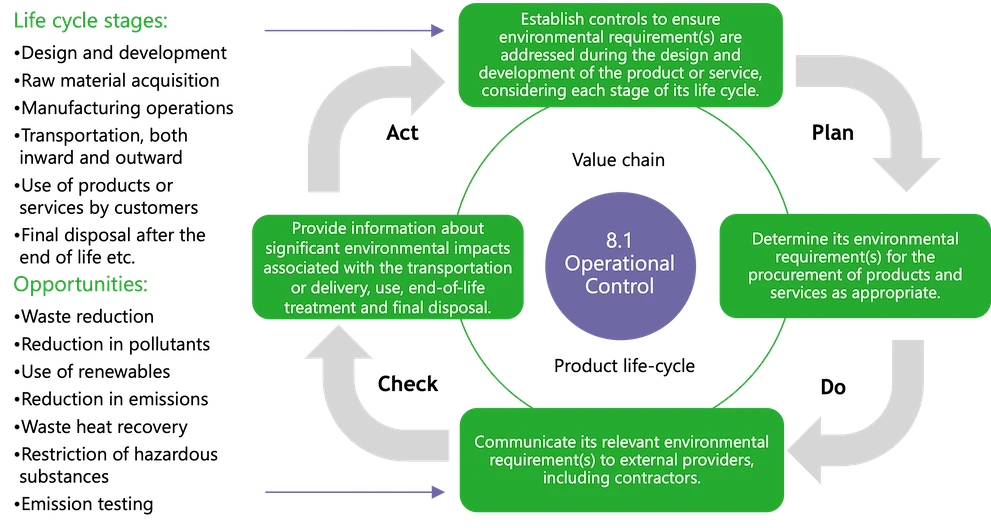
You should seek and record evidence that your organization has determined the design and its processes to meet the requirements of your customers and the requirements of your EMS.
Evidence that the process, including all inputs, outputs, resources, controls, criteria, and process measurement and performance indicators being planned should be sought.

Changes
Planned changes should be controlled, or unintended changes reviewed for their consequences.
Controls can include engineering controls, procedures, documented procedure, etc. They can be implemented following a hierarchy (e.g. elimination, substitution, administrative) and can be used singly or in combination.
Life Cycle Perspective
To design and develop products and services taking into account the environmental impact throughout their life cycle.
Include environmental requirements in the purchasing specifications of products and services, and communicate these environmental requirements to external providers.
When necessary, provide information on potential environmentalimpacts related to the transportation, use, end of life treatment and final disposal of its products and services.
Considering that some of your organization’s environmental impacts can occur once the products and services have been delivered to the customers, organizations need to provide information to those that will transport, use, treat or dispose of the products and services in order to prevent adverse environmental impacts.
Your organization´s ability to exert control or influence can vary from full control to no influence.
Out-sourced Processes
Outsourced process affecting EMS compliance must be controlled or influenced.
Auditors will be alert and identify instances of outsourcing highly pollutant processes with the intention of dropping them out of EMS.

Controls to Prevent Environmental Impacts
Considering that some of the organization’s environmental impacts can occur once the products and services have been delivered to the customers, organizations need to provide information to those that will transport, use, treat or dispose of the products and services in order to prevent adverse environmental impacts.
Consistent with a life cycle perspective, your organization needs to:
- Establish controls, as appropriate, to ensure that its environmental requirements are addressed in the design and development process for the product or service, considering each stage of the life cycle
- Determine its environmental requirements for the procurement of products and services, as appropriate
- Communicate relevant environmental requirement(s) to external providers, including contractors
- Consider the need to provide information about potential significant environmental impacts associated with the transportation or delivery, use, end-of-life treatment and final disposal of its products and services
Certification Auditors will not expect to see a fully developed life cycle analysis. This is not a requirement of ISO 14001.
All operational factors must be determined and risks associated with health, safety and the environment must be managed in a way that conforms to the EMS policies.
Life Cycle Stage Examples
| Life cycle stage | Case study examples of Life Cycle Actions - including operational control or influence |
|---|---|
| Procurement | Supplier self-assessment initiative to provide accurate view of suppliers' maturity level in terms of regulation and substances of concern management. Avoiding the use of rare earth metals, these are a supply chain vulnerability and have high environment impacts at extraction |
| Design | Designing individual processes to increase efficiency. Better design leads to reduced energy consumption during the life of the product (e.g., energy saving mode. Selecting materials that can more easily be recycled or biodegrade |
| Production | Using water-based primers can reduce Volatile Organic Compound (VOC) emissions. Improvement in the manufacturing process can reduce impacts from emissions and resource use |
| Logistics/delivery | Usage of re-usable packaging instead of single use cardboard, plastic or wood reduced resource use and environmental impacts associated with recycling. Logistics planning to optimise journeys |
| In use | Sustainable fuels can reduce carbon dioxide emissions on a life cycle basis compared to fossil fuel. Providing information to a customer on energy saving processes |
| Recycling and disposal | Provide information to customers on how to return their product so it can be disassembled and components re-used and recycled |

Documented Evidence for Operational Control
ISO 14001 does not prescribe these controls either instruction on how to implement them; however, it does need you to keep documented evidence for auditing purposes and to ensure that;
- You are meeting all compliance and legal requirements
- You have assessed all environmental objectives, and the priorities have been set out
- You have defined all outsourced, internal and external
- You have identified, implemented, and evaluated any necessary training specifications and requirements
Largely dependent on your type of industry, an auditor will typically request to see training procedures, operational controls, emergency management procedures, and rectification procedures in the event of an accidental spill.
Related Information You Might Find Useful
- 8.1 Operational Control [ISO 45001]


