


 Integrated Manual

 Procedures
 Process Maps, Turtle Diagrams
 Reports & Forms
 Project Plan
 18-Step Implementation Checklist
 Gap Analysis
 Internal Auditing
 Automated Charts
 Guidance
 Training
 Help & Support
 Easy to Edit


IMS Documentation, Structure & Auditing Explained
Contents
What Is an Integrated Management System?
An integrated management system (IMS) combines two or more ISO standards — typically ISO 9001 (quality), ISO 14001 (environmental) and ISO 45001 (occupational health & safety) — into a single, unified management framework. Instead of running three separate systems with duplicated policies, procedures and audits, an IMS brings everything together under one roof.
The reason integration works so well is that all three standards share the same high-level structure, known as Annex SL. This means the clause numbering, core concepts, and the Plan-Do-Check-Act cycle are identical across the standards. Clauses like Context of the Organization (4), Leadership (5), Planning (6) and Performance Evaluation (9) have the same intent in each standard — making it straightforward to address multiple requirements with a single set of documents.
For organisations that are already certified to ISO 9001 and looking to add ISO 14001 or ISO 45001, an integrated approach avoids starting from scratch. You build on what you already have — extending your existing management review, internal audit programme, document control and corrective action processes to cover the additional requirements for environmental and health & safety management.
The result is less paperwork, fewer audits, lower costs, and a system that your people will actually use — because they only have one set of procedures to follow, not three.
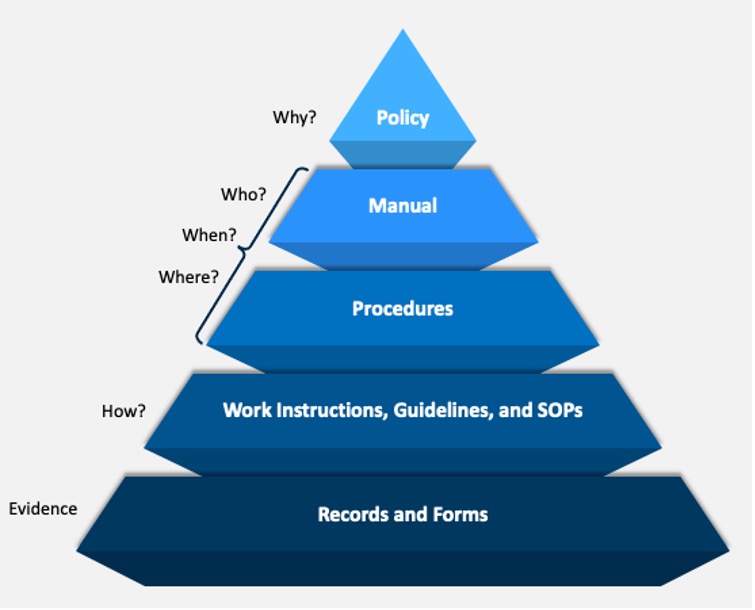
The 5 Levels of IMS Documentation
One of the most common questions about integrated management systems is how to structure the documentation. The IMS documentation pyramid provides a clear, five-level hierarchy that organises everything from top-level policy down to day-to-day records.
Level 1 — Policy
The policy sits at the very top of the pyramid and answers the question: why? It defines the organisation’s commitments to quality, environmental responsibility and occupational health & safety. The integrated policy sets the direction and tone for the entire management system — it is owned by top management and communicates the organisation’s intent to customers, employees and other interested parties. Everything in the pyramid below flows from the commitments made here.
Level 2 — Integrated Manual
The integrated manual answers the questions: who, when and where? It defines the scope of the management system, references the applicable standards (ISO 9001, ISO 14001 and ISO 45001), and describes how the organisation is structured to deliver on its policy commitments. The manual provides the framework that connects the policy above to the procedures below. This is the document that external auditors will review first to understand how your system is organised.
Level 3 — Procedures
Procedures describe how the organisation carries out its key processes. In an integrated system, procedures cover requirements that span multiple standards — for example, a single document control procedure serves ISO 9001 clause 7.5, ISO 14001 clause 7.5, and ISO 45001 clause 7.5 simultaneously. Typical IMS procedures include management review, internal auditing, corrective action, risk assessment, emergency preparedness, competence and training, and operational control.
Level 4 — Work Instructions, Guidelines and SOPs
Work instructions and standard operating procedures provide the step-by-step detail for specific tasks and answer the question: how? Process maps give a visual overview of how each procedure flows from input to output, while turtle diagrams capture the who, what, how and with-what for each process. These documents are where the integration really pays off — one process map can show how a single activity satisfies requirements from all three standards.
Level 5 — Records and Forms
Records and forms sit at the base of the pyramid and provide the evidence that your system is working. This level includes completed audit checklists, management review minutes, corrective action reports, inspection records, incident reports, training records and monitoring data. These are the documents your auditor will sample during a certification audit to verify that procedures are being followed.
Getting this structure right from the start makes implementation faster, audits smoother, and ongoing maintenance far simpler. Every document has a clear place in the hierarchy, and everyone in the organisation knows where to find what they need.

What Does an IMS Document Structure Look Like?
Organisations searching for an integrated management system template often want to know exactly what documents are needed. The following structure represents a typical IMS document set that covers ISO 9001:2015, ISO 14001:2015 and ISO 45001:2018 requirements:
Integrated Manual — A single manual covering all three standards, structured around the shared Annex SL clause numbering (clauses 4 through 10). The manual defines the scope, references applicable standards, and includes the integrated quality, environmental and OH&S policies.
Procedures — A typical integrated system requires around 30 to 35 procedures. These cover the shared requirements (document control, management review, internal audit, corrective action, competence and training) as well as standard-specific processes like environmental aspect identification, legal compliance evaluation, hazard identification and risk assessment, emergency preparedness, and operational controls.
Process Maps & Turtle Diagrams — Visual documentation that maps each procedure from input to output. A comprehensive IMS typically includes 50 to 60 process maps showing how activities flow across the integrated system, along with turtle diagrams that capture process owners, resources, methods and performance indicators.
Reports & Forms — The working documents that capture evidence of compliance: audit reports, management review minutes, corrective action forms, risk assessment templates, incident report forms, training records, environmental monitoring logs, and inspection checklists. A well-structured IMS will include upwards of 100 report and form templates.
Supporting Tools — The documents that help you implement and maintain the system: a project plan with milestones, an implementation checklist, gap analysis checklists for each standard, an internal audit programme with short-range and long-range schedules, and supplier assessment tools.
This is the structure our IMS template follows — 171 document templates covering every requirement across all three standards.

How to Audit an Integrated Management System
Auditing an integrated management system is one of the biggest advantages of the IMS approach. Instead of conducting three separate audits for ISO 9001, ISO 14001 and ISO 45001, you perform a single integrated audit that covers all three standards in one pass.
An integrated audit follows the same principles as any ISO internal audit — it is planned, systematic and evidence-based. The key difference is that each audit question can address requirements from multiple standards at the same time. For example, when auditing management review (clause 9.3), the auditor checks that quality performance, environmental performance and OH&S performance were all reviewed in the same meeting, using a single set of minutes.
Planning the Audit Programme — Your integrated audit programme should cover all clauses of all three standards over a defined cycle (typically one to two years). Using a process-based approach, you can audit a department or process and check its compliance across quality, environmental and health & safety requirements in a single visit, rather than auditing the same area three times.
Using an Integrated Audit Checklist — An integrated checklist combines the requirements of ISO 9001, ISO 14001 and ISO 45001 into one document, organised by clause number. Because the standards share the same high-level structure, many questions are common across all three. Standard-specific requirements (such as environmental aspects under ISO 14001 clause 6.1.2, or hazard identification under ISO 45001 clause 6.1.2.1) are clearly marked so auditors know which requirements apply to which standard.
Reporting and Corrective Action — A single integrated audit report captures findings across all three standards, with nonconformities and observations linked to the specific clause and standard they relate to. This feeds into a unified corrective action process, avoiding the duplication of separate tracking systems.
The time and cost savings are significant. Organisations that move from separate audits to an integrated approach typically reduce their total internal audit time by 30 to 40 percent, while achieving more thorough coverage.

Frequently Asked Questions
What is an integrated management system (IMS)?
An integrated management system combines two or more ISO standards into a single, unified framework. The most common integration is ISO 9001 (quality), ISO 14001 (environmental) and ISO 45001 (health & safety). Because these standards share the same high-level structure (Annex SL), their requirements can be addressed by a single set of policies, procedures and records — reducing duplication and simplifying management.
What are the 5 levels of documentation in an IMS?
The IMS documentation pyramid has five levels: Level 1 is the policy, which defines the organisation’s commitments and answers "why?" Level 2 is the integrated manual, which defines the scope, structure and responsibilities. Level 3 covers procedures that describe how key processes are carried out. Level 4 includes work instructions, guidelines, SOPs, process maps and turtle diagrams that provide step-by-step detail. Level 5 consists of records and forms that provide the evidence the system is working. This structure ensures every document has a clear purpose and place in the hierarchy.
What documents are needed for an ISO 9001 + ISO 14001 + ISO 45001 IMS?
A comprehensive IMS typically includes an integrated manual, 30 to 35 procedures, 50 to 60 process maps with turtle diagrams, and over 100 report and form templates. You will also need supporting tools such as gap analysis checklists for each standard, an internal audit programme, a project plan, and implementation checklists. Our IMS template provides 171 document templates covering all three standards.
How do you audit an integrated management system?
An integrated audit covers ISO 9001, ISO 14001 and ISO 45001 requirements in a single audit using a combined checklist. Because the standards share the same clause structure, one audit question can address requirements from multiple standards simultaneously. This approach typically reduces total audit time by 30 to 40 percent compared to conducting separate audits for each standard.
What are the benefits of integrating ISO 9001, 14001 and 45001?
The main benefits are reduced documentation (one set of procedures instead of three), fewer audits (one integrated audit instead of three), lower costs (less management time, fewer external audit days), better consistency (everyone follows the same system), and improved cross-functional visibility. Organisations also find that an integrated system is easier to maintain and update, because changes only need to be made once.
What is a documentation pyramid in an integrated management system?
The documentation pyramid is the five-level hierarchical structure used to organise IMS documents. At the top sits the policy (why), followed by the integrated manual (who, when, where), then procedures (how processes work), then work instructions, guidelines and SOPs (how tasks are done), and finally records and forms at the base (evidence). This pyramid structure ensures that every document traces back to the policy commitments at the top, and that evidence at the bottom supports what the procedures describe.


