
8.1 Operational Planning and Control
Have controls for hazards and risk controls been planned and included in operational controls and do these allow for capabilities of the workforce? Are these documented where necessary?
Contents

8.1.1 General
Arrangements for planning, implementing and controlling the processes needed to ensure:
1. Assessments of Hazards and Management of Risk
- Risk assessments
- Safety analysis;
- Design Failure Modes & Effects Analysis (DFMEA)
- Process Failure Modes & Effects Analysis (PFMEA)
- Failure Modes Effects & Criticality Analyses (FMECA)
- Fault tree analysis
2. Analysis, Reporting and Communication of Occurred Events
- Data collection and analysis
- Internal escalation process
- Mandatory reporting
- Safety alert reports
- Operating performance and trends
- Lessons learned
- Industry experience
- Safety reviews
3. Training & Communication
- Health and safety policies
- Promoting a safety culture
- Safety training
- Awareness initiatives
- Safety notices, safety alerts;
- Individual reporting mechanisms
Using the Hazard Identification Register as basis, formally risk assess each activity and risk, and implement the necessary controls as appropriate. Provide awareness briefings to all affected workers and contractors.
8.1.2 Eliminating Hazards And Reducing OH&S Risks
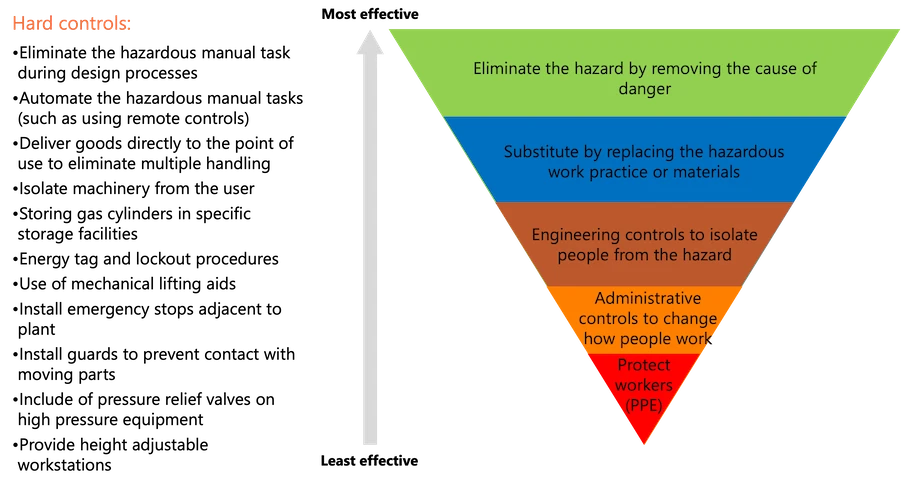
Is the hierarchy of OH&S controls correctly applied? Your organization must establish a process and determine the controls needed for achieving reduction in OH&S risks using following hierarchy:
1. Results of the context analyses (see 4.1 and 4.2) Hazard Elimination: avoiding risks, adapting work to workers, (integrate health safety and ergonomics when planning new work places; create physical separation of traffic between pedestrians and vehicles.
2. Substitution: replacing the dangerous by non-dangerous or less dangerous (replacing solvent-based paint with water-based paint).
3. Engineering Controls: Implement collective protective measures (isolation; machine guarding; ventilation; noise reduction etc.).
4. Administrative Controls: Giving appropriate instructions to workers (lock out processes; induction; forklift driving licenses, etc.).
5. Personal Protective Equipment (PPE): Provide PPE and instructions for PPE utilization/maintenance, i.e., safety shoes, safety glasses, hearing protection, chemical & liquid resistant gloves; electrical protection gloves, etc.).
8.1.3 Management Of Change
Change brings risk, whereas managing change reduces the risk. When changes to the operation are planned, is the effect on the OH&S management system considered? Documented information needs to be retained relating to planned changes and their potential impact on the OH&S management system.
Examples of Typical Changes Might Include:
1. Changes to the Organization
- Change in ownership
- Relocation
- Opening a new facility
- Change in the scope of work
- Introduction of a new technology (e.g., machine, inspection)
- Change in the organization (work sharing either internally between facilities or externally with partners/suppliers)
- Change in the parts of the organization that contribute directly to airworthiness or conformity
- Change to the quality assurance or independent monitoring principles
- Change of supplier(s)
2. Changes to Responsibilities
- Change of the Health and Safety Manager and/or associated reporting lines
- Change of head of the organization (Accountable Manager)
- Change of responsibilities affecting product quality and product safety
3. Changes to the Principles of Procedures related to
- Classification of changes and repairs as major or minor
- The approval of changes and repairs
- The approval of minor changes to the health and safety manual
- Configuration control
- Quality management system
- The acceptance of tasks undertaken by partners or suppliers
- Substantive new manufacturing processes
- Manufacturing planning
- New or modified security privileges for approved organizations
Why Reinvent The Wheel?

4. Changes to Resources
- Substantial reduction in the number, qualifications and/or experience of staff
- Substantial increase in the number of staff
- Changes in the intended use of the product (e.g., where new usage of the product is out of the qualified/certified design limitations)
Changes may have various positive or negative safety impacts. Any change that may have an adverse effect on safety shall be identified and managed through the Company’s existing processes for hazard identification, risk assessment and mitigation.
Risk assessment is a key part of the process, so when you decide to make a change, start by assessing the overall risk of the change itself. You should include a risk assessment of each issue, so that you can take any necessary steps to minimize the risks and their potential effects.
Example Change Management Process
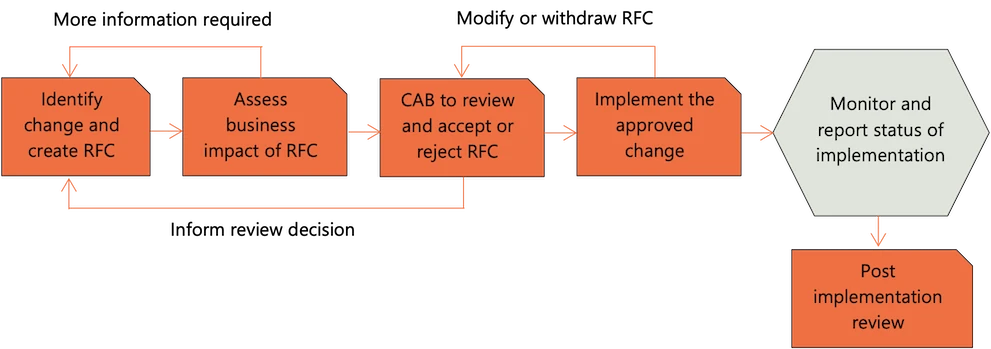
RFC (Request For Change) Should be Assessed Thus
- Identify the nature and scope of the change(s)
- Perform an initial risk assessment study covering
- The Company’s operational procedures
- Work organization (staffing, composition of the teams, scheduling, additional training, etc.)
- Infrastructure (relocation, parking base, etc.)
- Maintenance of equipment
- Perform a Safety Risk Analysis
- Identify hazards related to implementing the proposed change and their possible consequences
- Identify existing risk controls and define, as appropriate, additional mitigation measures
- Identify key personnel who will assist in implementing the change and the mitigation measures required and involve them in the change management process
- Define an implementation plan
- Assess related financial costs
- Communicate the proposed change to the staff and involve them in the project to garner their support
- Implement the actions as defined in the plan
- Check the overall effects through the established performance monitoring and measurement process
Whether it is the introduction of a new equipment, a new maintenance procedure, or a move to new premises, your OH&S Management System needs to cover the identification of any changes that may pose a risk to safety. These include the changes that would have a noticeable impact on your resources, materials, procedures, processes, training, management control, and above all your people.
Safety management requires that organizations manage the safety risks associated with organizational and operational changes. Staff concerns about workload, job security and access to training are associated with significant change in organizations and can have a negative impact on safety culture. The degree to which staff feel involved in the development of change and understand their role in the process will also influence the safety culture.
Start with Expert Templates, then Make Them Yours

8.1.4 Procurement
8.1.4.1 General
OH&S controls are now relevant to the purchase of goods and materials. Establish controls, within your existing procurement process, to ensure that the procurement of goods (for example products, hazardous materials or substances, raw materials, equipment) and services conform to your OH&S management system requirements. Prior to procuring goods & services, the organization should identify procurement controls that:
- Identify and evaluate potential OH&S risks associated with products, materials, equipment, service
- Requirements for products, materials, equipment, services to conform to OH&S objectives
- Need for information, participation and communications
- Before using verify equipment, installations and materials are adequate before being released for use by workers
- Items are delivered to specification and tested to ensure they function as intended;
Usage requirements, precautions or other protective measures must be communicated and made available.

8.1.4.2 Contractors
Controls and communication requirements with regard to contractor’s worker activities, the host company’s worker activities, and anyone who may be affected by the activity in the workplace. The establishment of controls and communication requirements with regard to contractor’s worker activities, the host company’s worker activities, and anyone who may be affected by the activity in the workplace.
Some of these contractors may not have (or require) an OH&S Management System, but you should make sure that they are not going to compromise safety for your organization. Even if the third party operates a health and safety management system, you should be prepared to check that it is effective. In either case, you might carry out an inspection or audit. If there is no OH&S Management System, there may be less to audit and it exposes your organization to more unknowns.
It is useful to work out a scheme for sharing safety data with your third-party contractors: their hazard and occurrence reports may alert you to a potential problem, and vice versa. This could be done through meetings with your key contracting organizations.
8.1.4.3 Outsourcing
The OH&S implications must be controlled as part of the purchasing process. Your organization must ensure that outsourced processes affecting OH&S management system are controlled.
An outsourced process is one that:
- Is within scope of your OH&S management system
- Is integral to your organization’s functioning
- Is needed for your OH&S management system to achieve its intended outcome
- Liability for conforming to requirements is retained by the organization
Organizations and external providers have a relationship where the process is perceived by interested parties as being carried out by your organization.

Related Information You Might Find Useful
- 8.1 Operational Control [ISO 14001]

 ISO 45001
 Process Maps
 Reports & Forms
 Checklist


