
What Are The Needs And Expectations Of Interested Parties for ISO 14001?
ISO 14001 Clause 4.2 requires an organization to identify who their interested parties are and to assess their needs and expectations for inclusion into the environmental management system.
The needs of these interested parties should be considered within the environmental management system since their expectations and conditions may impose varying obligations on your business.
Contents
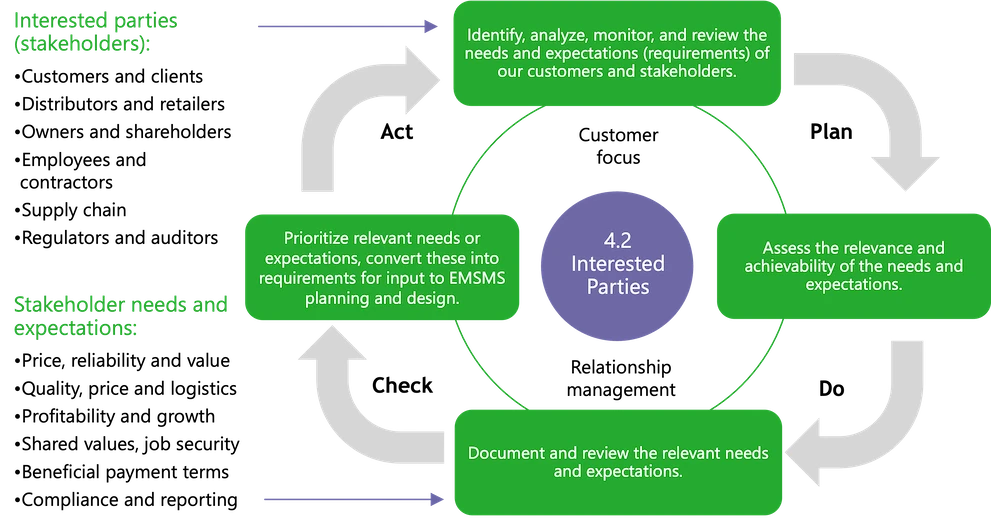
Who are 'Interested Parties'?
Interested parties are individuals or groups of people (stakeholders) who are interested in the environmental performance and operations of your business.
As such, you will need to determine which of their needs and expectations will become a compliance obligation.

Identify your Interested Parties
Ensure that your organization has properly identified its interested parties, and subsequently determined if any of their needs and expectations to be adopted as a compliance obligation.
Interested parties may change throughout the business’s lifespan; that is why the environmental management system needs to be reviewed and revised regularly (improved).
Examples of Interested Parties
Examples of interested parties include: customers, communities, contractors, suppliers, regulators, NGOs, and business partners, etc.
- Governments and governmental bodies
- Environmental, health and safety agencies and regulators
- Suppliers and contractors
- Certification bodies and authorities
- Commercial trade associations and industry associations
- Customers and consumers
- Community and neighbours. including neighbouring industries
- Academic institutions and employment agencies
- Employees
- Owners and investors
- Research bodies
- Non-governmental organizations, non-profit organizations, campaign groups and charities
- Media
- Insurance providers
- Emergency responders
Interested parties can have an impact on your company, so careful consideration of their requirements is necessary.
Interested Parties - Example Matrix
Although not specifically required, objective evidence should ideally comprise a list, or a matrix of interested parties, their corresponding needs and expectations, and an indication of which of these has been accepted as a compliance obligation.
| Interested Party | Environmental Needs | Environmental Expectations | Related Compliance Obligations |
|---|---|---|---|
| Environmental Protection Agency | Compliance with regulations and input to consultations | Accurate and timely reporting |
Licence/permit compliance and reporting Compliance with emission limits |
| Suppliers and Contractors | Clear specifications on what is expected of them relating to the environment | Consideration of supplier’s constraints and ability to support with environmental improvement |
Product specification stating environmental requirements Provide environmental criteria when selecting suppliers, vendors or vetting contractors |
| Community and Neighbours |
Product specification stating environmental requirements Provide environmental criteria when selecting suppliers, vendors or vetting contractors |
Providing a dedicated telephone line or email account for enquiries or complaints | Regular reporting of monitoring data |
In order to determine the relevancy of an interested party or their needs and expectations, your organization needs to answer: ‘Will this interested party (or their requirements) have an effect on the organization’s ability to achieve the intended outcomes of the environmental management system?’.
If the answer is ‘yes’, then their needs and expectations should be adopted as a requirement.
We suggest your rank the interested parties requirements according to their degree of Priority and their Relevance (e.g. 1 low, 5 high) to current objectives, policies and conformity of products and services as relevant to your EMS.
Communication
Communicating with stakeholders and interested parties, particularly in relation to compliance obligations is vital.
Communication with interested parties should be based on performance data generated by your organization’s EMS, which will require robust monitoring and measurement to ensure that the data is reliable.
You should ensure that the monitoring and measurement processes are included in the internal audit program so your organization can assure itself that the checking processes and validated and that the data it is communicating is accurate.

Related Information You Might Find Useful
- 4.2 Understanding the Needs and Expectations of Interested Parties [ISO 9001]
- 4.2 Understanding the Needs and Expectations of Interested Parties [ISO 45001]
- DNV GL guidance document - 4.2 Understanding the needs and expectations of interested parties


