
What is ISO 9001 Competence & Awareness?
Competence and Awareness defines the guidelines that must be followed by all staff in order to be considered competent and aware of the requirements. In other words, this procedure ensures that all employees are performing to their best ability in their specific areas of expertise.
Contents
- What is ISO 9001 Competence and Awareness?
- Purpose of the Competence and Awareness Procedure?
- Assess Staff Competencies
- Should I Document Competence and Awareness?
- How's Best to Document Competence and Awareness?
- Measuring Effectiveness
- The Competence and Awareness Procedure
- Duties and Responsibilities
- Competence & Awareness Procedure


Purpose of the Competence and Awareness Procedure?
The purpose of the Competence and Awareness Procedure is to define your organization’s process for undertaking the necessary actions and responsibilities for ensuring that the competencies needed to meet customer and other external or internal requirements, applicable to the business, are defined and actions are taken to meet these needs. This procedure also defines the responsibilities for planning, reporting and retaining associated records.
Don’t Try to Manage It All Alone!

When it comes to ISO 9001:2015 Competence (7.2) and Awareness (7.3), it is important to understand exactly what these guidelines are in order to avoid any unnecessary policy violations. Included under these particular clauses are requirements for how an organization can remain compliant with ISO 9001 certification requirements.
Assess Staff Competencies
Your organization should establish a process for assessing existing staff competencies against changing business needs and prevailing trends. Check for evidence that all staff which work under your organization’s control are competent, and that evidence continuing competence is maintained as documented information in accordance Clause 7.5.
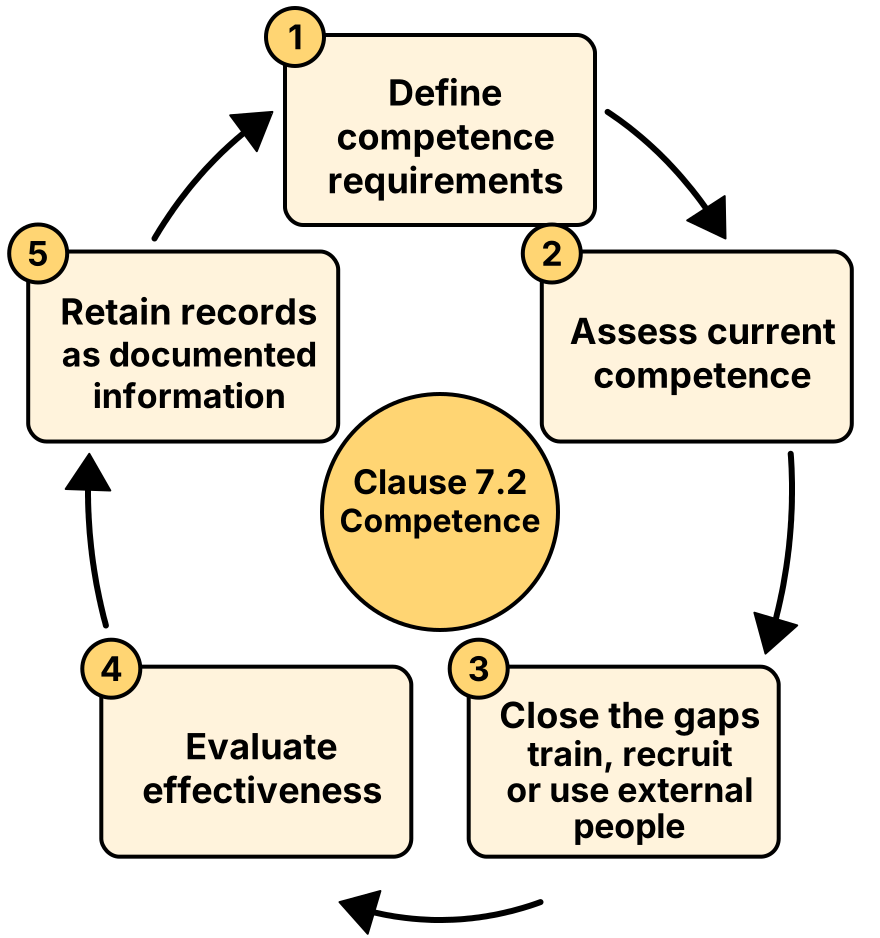
Define competency requirements by:
- Actively identifying training requirements
- Actively delivering training
- Actively monitoring the effectiveness of training
Training should never be performed as a knee-jerk reaction with no real objectives, but instead, it should be geared toward empowering each employee with the skills and knowledge they need to move the organization forward and enhance customer satisfaction.
Staff should be trained to improve their skills and overall performance. Comparing existing performance to post-training performance is a simple way of assessing the effectiveness of training.
Consider making provision for the following audit questions:
- What training is given to new employees?
- How is training evaluated?
- What steps are taken when training is deemed ineffective?
- What types training records are maintained?
Should I Document Competence and Awareness?
It is not a mandatory requirement to document your competence, training and awareness process, but since the competency of your staff is vital to achieving product and service conformance, you should always look to define and control this process. The implementation of a competence, training and awareness procedure should be a priority of all businesses.

How's Best to Document Competence and Awareness?
Develop and implement a procedure that defines:
- The responsibilities for coordinating training activities
- How training needs are determined
- How training is delivered
- How training is evaluated
- What records are maintained
Start with Expert Templates, then Make Them Yours


Measuring Effectiveness
Training alone is not sufficient to demonstrate competence; this must be demonstrated through tests, observations, results, etc. Auditors need to find objective evidence in order to determine that the competency requirements have been met.
If the people are found not to be competent, your organization is required to take action. The actions taken need to be evaluated for effectiveness in raising competence to the required level. Examples of action may include remedial training, recruitment or the use of external people in order to acquire the necessary competence.
Identification of employee training needs is typically the first step in developing a competency-based training program. In addition to existing workers, new hires, temporary workers and outside contractors must be included when identifying training needs. Your organization must demonstrate that the training needs for these employees were identified.
After developing a list of these employees, the management representative or human resources manager should establish the appropriate training program for each person based on the type of employee interaction with each significant impact or risk.
Even though some personnel may have the same job, the type or level of training may vary according to each person’s past education, training, and experience.
A register containing information on specified levels of education, training, and experience must be established for each employee whose work is involved with any significant impact. The planned training program for each individual then should be listed. The training sessions should, at a minimum:
- Make the employee aware of the aspects and hazards, and the impacts and risks associated with their work;
- Include training required by applicable regulatory requirements and management system requirements;
- Include training necessary to obtain/retain required licenses or registrations;
- Emphasize responsibility for minimizing significant impacts and risks associated with their work;
- Identify potential consequences of departures from specified operating procedures;
- Address the benefits of improved personal performance.
Training options may be as simple as on-the-job training, administered by senior/experienced members; formal training, including classroom instruction; training provided by external consultants.
For some situations, commercially available training courses may be another alternative. Additional or customized training activities specific to individual needs, job descriptions, regulations and goals may be necessary depending on the existing skill level of each employee.
The Competence and Awareness Procedure
The ISO Competence and Awareness Procedure consists of a variety of activities that should be carried out by the leaders of the company and within each individual department.
These activities help the company personnel to make sure that all employees are following the guidelines that have been set in place by the current version of ISO standards. In the list below, you will find the basic activities that must take place regularly in order to uphold these standards.
Procedure Activities
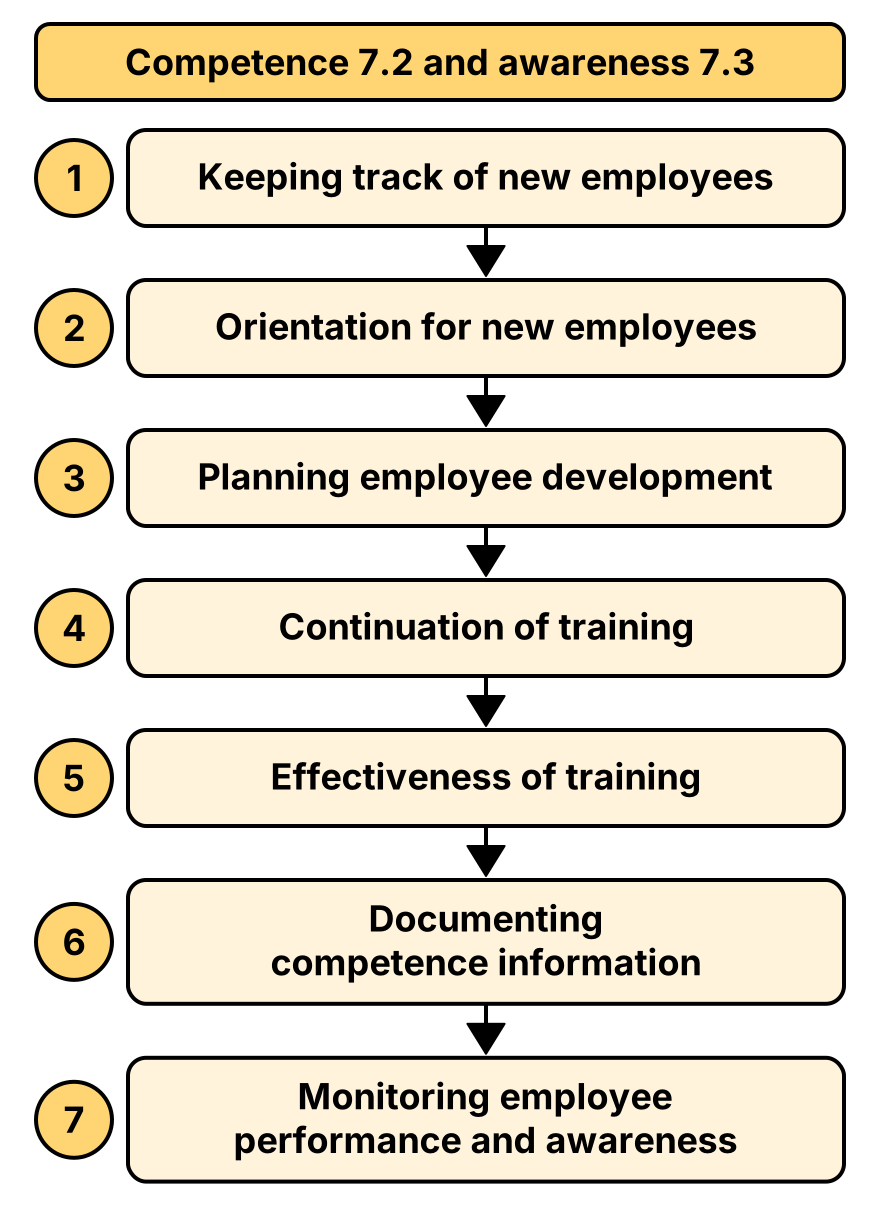
One of the first competence and awareness procedure activities includes keeping track of all new employees that enter the business. In addition to keeping a close eye on these employees, each of them will require an orientation to learn about the rules and regulations of the company that is competent with ISO 9001.
These activities also include the planning of employee development, which will help them to advance in the operations of the company, as well as a continuation of their training.
In other words, once a new employee has gone through orientation and initial training, they will continue to receive feedback and additional training that is more up to date in order to have the most effective results.
The appropriate overseeing manager will continue to document the competence information, keeping an individual record for each employee. They will also monitor employee performance and awareness of these regulations on a regular basis to maintain the quality standards that are outlined by ISO 9001.
Why Reinvent The Wheel?


Duties and Responsibilities
Under the ISO 9001 Competence and Awareness clause, there are specifications about the duties and responsibilities for each personnel that is working for the business in question. It is important for these responsibilities to be followed and carried out correctly for the most efficient business and quality of product or service.
There are three main categories in relation to the ISO 9001 Competence and Awareness responsibilities; human resources, department managers and managers. These departments separate the employees of a business in order to divide responsibilities to help the business run smoothly in its day to day operations.
- Human Resources
- Department Managers
- Managers
Human Resources Responsibilities
- Making training opportunities available to individual employees
- Keeping records of training and competence
- Assisting Department Managers with individual plans for training and competency
The Human Resources department, on the other hand, will work closely under the department manager to make sure that all employees are following the ISO 9001 regulations, while helping to come up with a plan in order to fix any issues that might arise with compliance.
This department is responsible for making training opportunities available to individual employees. In other words, Human Resources must personally make sure that each employee has received proper training as well as all of the information that they will need to know in order to be competent and aware of ISO 9001 guidelines.
In addition, Human Resources will keep specific records of training and competence and competence, assessing each individual employee’s performance very closely to quickly identify any violations of these regulations.
Assisting the Department Manager with the individual plans for each employee in order to make sure that they are properly trained and fully understand the procedures that they must follow, these two departments work together in order to keep the business running smoothly.
Department Managers Responsibilities
- Making sure department employees are competent
- Reviewing training and competence records with employees
- Assisting Human Resources manager with individual plans for training and competency
The department managers hold the position of overseeing each individual department within the business. These managers are essentially the highest position in this particular order, and will be responsible for working closely with the next department down, which is human resources.
The main responsibilities of the department managers when it comes to ISO 9001 competence and awareness will include making sure that all employees throughout the entire business are competent with these regulations.
Additionally, they will follow up with training and competence records that are kept for each individual employee that they supervise, reviewing them periodically with the employees themselves.
These should be constructive reviews where the employees are made aware of their progress in following the current ISO 9001 regulations and the status of their training. Should there be any issues with compliance with any employee in the area, the department manager would assist them in getting back on the right track.
The department manager assists the Human Resources manager with the individual training and competency plans for each employee as well. Since everyone is different, it is necessary to formulate a specific plan of action that will resonate well with each individual.
If the training plans are the same for everyone, they might prove to be less effective and could result in non-compliance of ISO 9001 guidelines.
Managers Responsibilities
- Creating requirements for competency for supervised employees
- Following up with employees to make sure they are competent
The managers of a company, which oversee the lower levels of employees directly, will work even more closely with the personnel that they supervise. Managers are an integral part of creating the requirements for competency for each individual employee that works under them.
Tasked with following up with their employees to make sure that they are competent, the managers will ensure that the guidelines that were set by the higher departments are being directly followed by the employees that they were customized for.
To conclude, ISO 9001 Competence and Awareness Procedure is in place in order to make sure that all operations are running smoothly and all company personnel are doing their parts to ensure that the guidelines are being adhered to.
Jump Start Your Documentation

Following a system of hierarchy where the highest departments work together to pass down specific plans of action for how each employee can most effectively learn their responsibilities for upholding the company’s quality standards, the Competence and Awareness Procedure helps to keep a company working like a well-oiled machine.
Related Information You Might Find Useful
- Human Resources Procedure [ISO 9001]
- 7.2 Competence [ISO 14001]
- 7.3 Awareness [ISO 14001]
- 7.2 Competence [ISO 45001]
 ISO 9001
 Process Maps
 Reports & Forms
 Checklists


