
What Is Documented Information In ISO 9001:2026?
The term “documented information” in ISO 9001 refers to all of the important information within a business that must be kept organized and controlled.
It is basically a combination of:
- Documents; and
- Records
Contents

Don’t Try to Manage It All Alone!


Documented Information Explained
In previous versions of ISO standards, the terms “documents” and “records” were formally used to refer to the important information and data that exists within a company.
In the 2015 edition these terms were combined under the single term “documented information”, and ISO 9001:2026, published on 16 September 2026, keeps it. For the simplest explanation of what this means in terms of ISO 9001, you can think of it as documents and records together.
ISO 9001:2026 (Clause 3.10) defines documented information as information required to be controlled and maintained by an organization, and the medium on which it is contained. Records are usually retained for long periods of time, while documents hold data that is maintained and frequently updated or added to.
In other words, a document can be thought of as a sheet of paper with blank fields for certain types of data or information. The document is the blank paper, but it will become a record when a manager or employee fills it out. To see where documents and records sit in a QMS, read how QMS documents are structured.
Both of these methods of documenting information are equally as important, which is why they have been combined into one in the current ISO 9001 guidelines, now being recognized as just “documented information”.
ISO 9001 Documented Information Overview
- Combination of documents and records into one term
- Documents - maintain information (ISO 9001:2026 says “shall be available as documented information”)
- Records - retain information (ISO 9001:2026 says “shall be available as evidence of”)

Requirements for Documented Information
What are the ISO 9001 documented information requirements?
- Does not require procedures
- Does not require a quality manual
- Requires both documents and records of different types
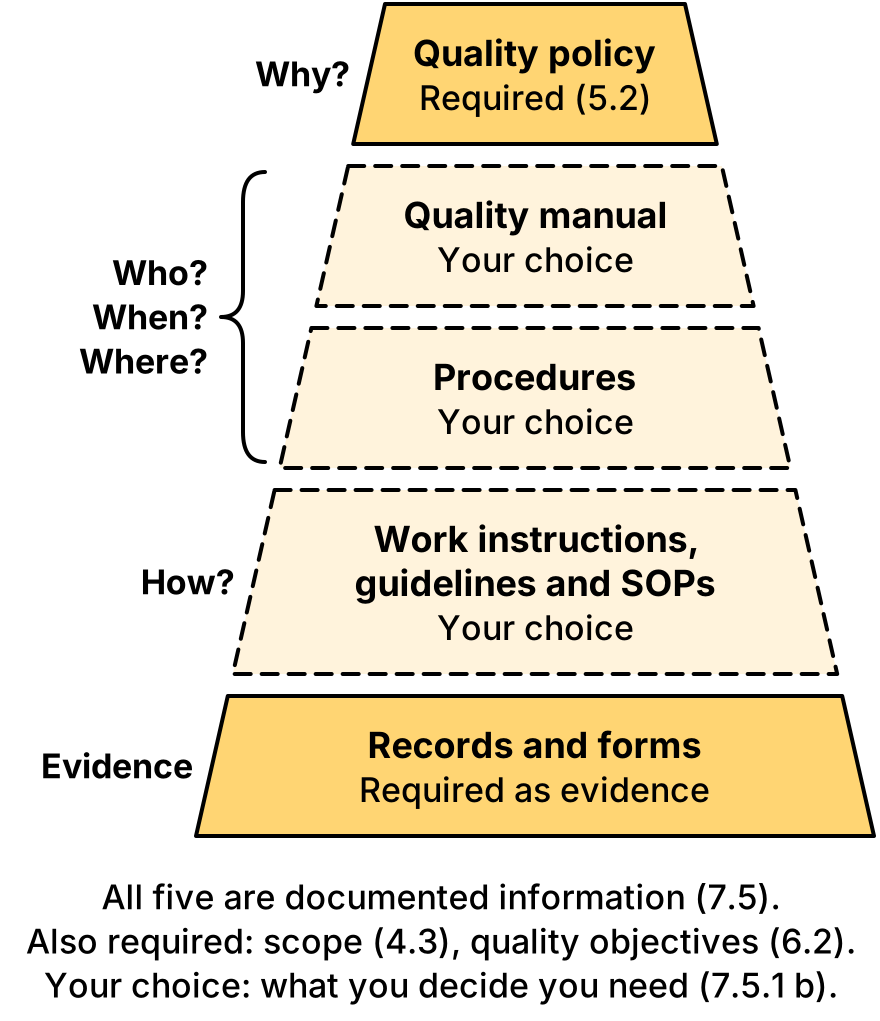
Unlike the 2008 edition, ISO 9001:2026 (like the 2015 edition before it) does not require any documented procedures.
In addition, a quality manual is no longer required in order to be compliant with this set of regulations. The documented information that is mandatory under ISO 9001:2026 includes both documents and records of different types, which will be discussed in more detail in the next section.
Start with Expert Templates, then Make Them Yours

What Documented Information is Required for ISO 9001?
The documented information that is required to meet ISO 9001 standards includes a variety of both documents and records.

MAINTAIN the Documented Information Required for ISO 9001
Your organization must control this documented information and keep it up to date. ISO 9001:2026 says it “shall be available as documented information” (the 2015 edition said “maintain”). Your QMS documentation should be updated as needed based on any system improvements you implement, but keep it simple!
Maintain the following data as ‘documented information’:
- The scope of the quality management system (4.3)
- Information necessary to support the operation of QMS processes (4.4)
- The quality policy (5.2)
- The quality objectives (6.2)
- Documented information required by ISO 9001:2026 (7.5.1 a)
In short, these documents display information about the company's processes, both their current and future operation.

RETAIN the Documented Information Required for ISO 9001
ISO 9001:2026 says this documented information “shall be available as evidence of” (the 2015 edition said “retain”). Keep the following as evidence of process compliance:
- Evidence that processes are being carried out as planned (4.4.2 b and 8.1)
- Evidence of fitness for purpose of monitoring and measuring resources (7.1.5.1)
- Evidence of the basis used for calibration of the monitoring and measurement resources (7.1.5.2)
- Evidence of competence of people doing work under the control of the organization that affects the performance and effectiveness of the QMS (7.2)
- Documented information required by the QMS (7.5.1b)
- Evidence of the conformity of products and services (8.1)
- Results of the review of requirements for the products and services, and any new requirements (8.2.3)
- Records to demonstrate compliance with design and development requirements (8.3.2)
- Records of design and development inputs (8.3.3)
- Records of the activities of design and development controls (8.3.4)
- Records of design and development outputs (8.3.5)
- Design and development changes, including the results of the review and the authorization of the changes and necessary actions (8.3.6)
- Records of the evaluation, selection, monitoring of performance and re-evaluation of external providers and any actions arising (8.4.1)
- Evidence of the unique identification of outputs when traceability is a requirement (8.5.2)
- Records of property of the customer or external provider that is lost, damaged or non-conforming and of its communication to the owner (8.5.3)
- Results of the review of changes for production or service provision, the persons authorizing the change, and necessary actions taken (8.5.6)
- Records of authorized release of products for delivery to the customer including acceptance criteria and traceability to the authorizing person(s) (8.6)
- Records of non-conformities, actions taken, concessions and the identity of the authority deciding the action in respect of the nonconformity (8.7)
- Results of the evaluation of the performance and the effectiveness of the QMS (9.1.1)
- Evidence of the implementation of the audit program (9.2.2)
- Evidence of internal audit results (9.2.2)
- Evidence of the results of management reviews (9.3.3)
- Evidence of the nature of the nonconformities (10.2.2)
- Evidence of any subsequent actions taken to correct non-conformities (10.2.2)
- Results of any corrective actions (10.2.2)
As mentioned in the previous section, the records are meant to retain specific information about the company. These records include information about the QMS processes, resources, and measurement traceability.
When it comes to the design and development of a product, there is a detailed process outlined in ISO 9001 in six parts (8.3.1 to 8.3.6). A few of these steps require detailed records to be kept, and are referred to in this list of records as design and development planning, inputs, controls, outputs, and changes.
In short, these records are kept throughout the stages of a product's development. From the time the product is planned out and the functions and uses are defined to the first prototype and any changes that need to be made, everything is written down and kept as a record for future reference.
Why Reinvent The Wheel?

Throughout this entire process, the company personnel are required to write down their progress and any changes that are taking place in any way that they choose. For this specific category of records, the ISO 9001 regulations do not specify what type of records must be kept during these stages.
In other words, there is no specific document that must be filled out during the product development stages, as long as all of the necessary information is recorded. So, if a company would like to document this information in sketches or write an instructional manual of how to operate the product, these records will be adequate.
The rest of the records required within the documented information clause cover a wide range of processes and functions throughout the business. For instance, they cover monitoring and measuring equipment, external providers, changes to production and the release of products and services.
Evidence of employee competence must be kept (7.2), and most organizations also keep information about customer satisfaction as part of the results of performance evaluation (9.1.1). Competence records show that each person is competent for their work on the basis of education, training or experience, and are updated as that changes.
The Nonconformity and Corrective Action record will help the management of the company keep track of nonconformities, the actions taken and the results of any corrective action (10.2.2).
All in all, the documented information clause of ISO 9001 is meant to help a company organize all of the vital documents and records that make the business run smoothly.
When a company is compliant with the ISO 9001 regulations, it can efficiently manage daily operations, finances, employee training, product development, and more.
What about ISO 9000?
With both documents and records included under the term “documented information,” there are plenty of ways for compliant businesses to understand their current position while working to improve it.
7.5.1 General
The terms ‘documented procedure’ and ‘record’ used in the 2008 edition of ISO 9001 were both replaced, from the 2015 edition onwards, by the term ‘documented information’, which is defined as information required to be controlled and maintained by an organization, as well as the medium on which it is contained.
A robust document control process is at the heart of a quality management system; almost every aspect of auditing and compliance verification is determined by scrutinizing documented evidence.
An organization must control the documentation required by the quality management system and define the controls needed to approve, review, update, identify changes, identify revision status and provide access. A document control procedure is the usual way to do this, although ISO 9001:2026 does not require one; it should clearly define the scope, purpose, method and responsibilities required to implement these parameters.
In order to comply with the document control clause, it is essential that all personnel understand:
- what type of documents should be controlled
- how this control should be exercised
To get the most out of your document control procedure it must communicate the steps necessary to ensure that staff and other users of the organization’s documentation understand what they must do in order to manage that information effectively and efficiently.
Departmental managers should always be responsible for promoting good document and record management practices in their area whilst supporting overall compliance to the document control procedure.
Individuals and their line managers should be responsible for the documents and records that they create, as well as being responsible for their retention and disposal in line with legislative requirements and organizational procedures and practices.
It should be noted that there is no need to maintain a documented procedure but organizations may still choose to operate one. Ensure that the organization’s management system includes documented information required by ISO 9001:2026, and the documented information identified by the organization to demonstrate the effective operation of its QMS as defined below.
Operational procedures, work instructions, flow charts, process maps, signs, placards, container markings, labels etc. are all examples of ‘documented information’. Documented information can be in any format and media and from any source.
The organization needs to determine the level of documented information necessary to control its QMS. ‘Access’ can imply a decision regarding the permission to view the documented information only, or the permission and authority to view and change the documented information.
Jump Start Your Documentation


7.5.2 Creating and Updating
You should seek to confirm that when documented information is created or updated, your organization has ensured that it is appropriately identified and described (e.g. title, date, author, reference number).
It must be in an appropriate format (e.g. language, software version, graphics) and on appropriate media (e.g. paper, electronic). Confirm that documented information is reviewed and approved for suitability and adequacy.
Documents that you use as a business should have clear document control. You will already be used to doing this. It also expects a clear format and for it to be approved. This is to prevent anyone just using documents that they see fit.
It seems slightly unnecessary when you are a SME as there may be a very small team or even one of you. For larger businesses this is really important so that documents are used properly and changes that have been incorporated for the good don’t get lost when someone else doesn’t understand them or removes them.

7.5.3 Control of Documented Information
A robust document control process invariably lies at the heart of any compliant management system; almost every aspect of auditing and compliance verification is determined through the scrutiny of documented information. With this in mind, it becomes apparent that the on-going maintenance of an efficient document management system must not be overlooked.
Your organization must control the documented information required by the QMS and by ISO 9001:2026 itself (Clause 7.5.3). A suitable process must be implemented to define the controls needed to; approve, review, update, identify changes, identify revision status and provide access. The documented information process should define the scope, purpose, method and responsibilities required to implement these parameters.
In order to comply with the documented information requirements, it is essential that all personnel understand what types of information that should be controlled and more importantly, how this control should be exercised.
To get the most out of your documented information process, it must be communicated to ensure that staff and other users of the documented information understand what they must do in order to manage that information effectively and efficiently. Demonstrate the organization's arrangements for controlling documented information required by ISO 9001 and your organization’s own requirements, including:
- Availability e.g. document accessibility (hard copy, electronic media), readily available at the point of use;
- Suitability e.g. format, media suitable to the environment, ease of understanding, language, interpretation;
- Protection e.g. document authentication, document markings (official, secret, restricted, confidential, private, sensitive, classified, unclassified), access controls (individual, role specific),
- Physical security (master documents, server rooms, libraries) IT security (User ID, password, servers, download, back up, encryption, ‘read only’, ‘read/write’), protection from corruption and unintended alterations.
Demonstrate the organization's arrangements for document retention e.g. organization/legal/contractual retention periods, storage, preservation, back up, retention of knowledge, disposal, obsolescence e.g. withdrawal, replacement, legacy archive and suitable identification (‘for information only’, ‘not to be used after….’, ‘uncontrolled copy’, ‘for reference purposes only’, etc.).
Describe how the organization protects electronic data, e.g. security policy, system access profiles, password rules, storage and back-up policy including protection from loss, unauthorized changes, unintended alteration, corruption, physical damage
Access can imply a decision regarding the permission to view the documented information only, or the permission and authority to view and change the documented information.
Departmental managers should always be responsible for promoting good documented information practices in their area whilst supporting overall compliance to the requirements.
Individuals and their line managers should be responsible for the information that they create, as well as being responsible for their retention and disposal in line with legislative requirements and organizational needs.

Related Information You Might Find Useful
- 7.5.2 Creating and Updating Documented Information
- 7.5.3 Control of Documented Information Explained
- 7.5 Documented Information [ISO 14001]
- 7.5 Documented Information [ISO 45001]
 ISO 9001
 Documented Information Procedure
 Reports & Forms
 Training


